Uluwatu With Kids: The Honest Family Guide to the Bukit Peninsula
Uluwatu is famous for surfers and cliff-edge villas — but it works for families if you pick the right beach, the right villa and the right driver.
Last reviewed:
Uluwatu shows up on every Bali highlight reel: dramatic limestone cliffs, world-class waves, infinity pools sliced into the headland. What the photos do not show is the staircase. Or the monkey ripping a water bottle out of a toddler's hand. Or the 45-minute drive between two beaches that looked, on the map, like they were next door. Uluwatu absolutely works with kids in 2026 — but it works very differently to Sanur or Ubud, and choosing the wrong beach or the wrong villa is the difference between a brilliant week and a tearful one. This is the parent-to-parent guide we wish we had on our first Bukit trip.
The Bukit Peninsula in one paragraph
Uluwatu is not really a town. It is the southern tip of Bali — the Bukit Peninsula — a dry, elevated limestone plateau that sits roughly 40 to 50 minutes south of the airport on a good run, longer in afternoon traffic. The whole region is built around surf breaks tucked under cliffs, which is exactly what makes it photogenic and exactly what makes it awkward with small kids. Most beaches are not at road level. You access them by stone steps, cave staircases, or in a couple of premium cases, a private inclinator carved into the rock.
The plateau itself is flat and breezy, dotted with villas, surf cafes and the occasional warung. Distances on the Bukit feel small on a map and large in the car. Padang Padang to Melasti looks like a five-minute hop and is closer to twenty-five. Add a school-finish-time traffic snarl on the single main road and you are easily at forty. Plan one anchor activity per day, not three.
The upside of all this: Uluwatu has the best sunset views in Bali, genuinely good infinity-pool villas at prices that surprise Australian families used to Byron rates, and an absence of the moped-clogged chaos you get in Canggu. For families with kids aged roughly three and up — and for babies who are happy in a carrier — it is a wonderful base. For families with crawling babies, prams and reflux-prone routines, it requires more care.
Beach access reality — the part nobody tells you
This is the single biggest thing to understand before you book. The famous Uluwatu beaches were never designed for visitors with strollers. They were carved out by surfers looking for shortcuts down the cliff. Some of those shortcuts are now concrete and signposted, but the geometry has not changed.
Padang Padang is the iconic Eat Pray Love beach. To reach the sand you descend a steep, narrow stone-step passage that squeezes between two boulders. It is not pram-friendly. It is also not particularly toddler-friendly in flip-flops on a wet day. With a baby in a soft carrier and a confident four-year-old who can hold a railing, it is doable. With a 14-month-old still wobbly on stairs, it is a one-adult-per-child operation and you will not be carrying a beach bag down at the same time. The sand itself, once you get there, is gorgeous and the swimming is calmer than its big sibling Uluwatu Beach — but expect crowds and a packed entry path.
Bingin is worse. The descent is longer, steeper, and the steps are uneven concrete that locals have built piecemeal over the years. Surfers love it. We would not take a child under five down it unless they were a competent walker and we had a second adult to spot.
Suluban (Blue Point) is a beautiful sea-cave beach reached by a long flight of stairs that then squeezes through an actual cave opening — fun for older kids, a nightmare with a baby. The sand mostly disappears at high tide, so check the tide chart before you commit to the climb.
Uluwatu Beach proper, directly under the temple, is for surfers only. There is a stair descent and the shorebreak is unforgiving. Skip it with kids.
The beaches that actually work with kids
The good news: the Bukit has a quieter second tier of beaches that are genuinely family-friendly. They just are not on the Instagram circuit.
Melasti Beach is the answer for most families. It sits on the eastern side of the peninsula and is reached by a remarkable paved switchback road carved down through the cliff face — yes, you drive all the way down. There is a proper car park at the bottom, a flat boardwalk along the back of the sand, sunbeds with umbrellas to rent and a row of casual beachfront warungs. The swimming is sheltered behind a reef shelf at low to mid tide and the sand is soft. It is the only beach on the Bukit where a pram makes sense, and the only one where you can land at the sand with a baby asleep in the car and not regret your decision. It does get busy with domestic tourists on weekends — go on a weekday morning for the quietest run.
Karma Kandara sits below the Karma resort and is accessed via a private inclinator — basically a cliff-side funicular. Day passes for non-guests fluctuate but they generally include a food and beverage minimum that you will easily clear with a family lunch. The beach itself is small, the water is calm, and the parental nervous system gets to switch off for a few hours. Worth the splurge once per trip if your kids are small.
Nyang Nyang is the wildcard. It is reached by a long flat walk (about twenty minutes from the parking area, on a dirt path) which means it filters out almost everyone. The sand is wide, the crowd is sparse, and there is almost no shade and no facilities. Take an umbrella, take water, take snacks, and you will have one of the prettiest beach mornings of your trip. Not for hot afternoons or for families without a toddler-carrier.
Pandawa on the eastern Bukit is similar in feel to Melasti — paved road access, parking, sunbeds, calm water at low tide. A reliable backup if Melasti is having a busy day.
Where to stay: cliff villas, plateau villas, and the pool-fence problem
Uluwatu's villa scene is the reason most families come. You can rent a three-bedroom private villa with infinity pool, full kitchen, daily housekeeping and a cook on-call for roughly what an average Gold Coast Airbnb costs in school holidays. The trade-offs are worth knowing.
The dramatic cliff-edge villas in Pecatu and Ungasan have the postcard view. They also tend to have stepped terraces, unfenced cliff drops at the property edge, and infinity pools that finish in a glass-edge wall above a hundred-metre void. With pre-walkers and confident toddlers this is manageable; with a newly-walking 14-month-old it is a constant low-grade vigilance tax that some parents enjoy and others find exhausting. Ask the villa directly for photos of every level and the pool edge before you book.
The plateau villas further inland — still on the Bukit but set back from the cliffs — give you 80 percent of the aesthetic with much friendlier geometry. Single-level layouts, walled gardens, pools that you can actually fence. They also tend to be cheaper.
Whichever you choose, the pool fence question is non-negotiable for under-5s. Almost no Bali villa comes with a permanent fence — it would ruin the architectural look the owner is selling. The standard solution is a freestanding pool fence that we and a few other Bali outfits hire by the night. Check our gear rental page for fences, plus cots, high chairs, sound machines and stair gates delivered to the villa before you arrive. Bringing a 12-kilo travel cot in a duffle on a 7-hour flight, when you can have a proper one waiting in the room, is a hill we will die on.
Uluwatu Temple at sunset with kids
Pura Luhur Uluwatu is one of the six sacred sea temples of Bali and the cliffside walk along the temple grounds is genuinely one of the great moments of any Bali trip. With kids it is also entirely doable — with rules.
The walk itself is along a paved path with railings, set well back from the actual cliff edge. With a confident toddler holding a hand it is fine. With a baby, use a carrier rather than a pram — there are short flights of steps and the path narrows. Aim to arrive around 5pm if you want a relaxed wander before sunset, or 5:30pm if you are also doing the Kecak dance. Wear a sarong; they are issued at the entrance.
The monkeys are the actual hazard. The Uluwatu macaques are clever, organised and trained over generations to swap stolen items back for food. Three rules: do not bring sunglasses (they will be taken off your head), do not bring loose water bottles or snacks (they will be taken from your hands), and keep babies in a carrier on your chest, not on a back-carry where you cannot see them. If a monkey approaches, do not make eye contact, do not smile (showing teeth reads as aggression), and let it pass. A monkey grabbing for a hat is normal. A monkey on a child's shoulder is a panic moment for the child and rarely a real bite risk, but absolutely worth avoiding.
If something is taken, the temple staff are remarkably effective at negotiating returns with bits of fruit. Do not chase a monkey. Do not try to wrestle a phone back.
The Kecak Fire Dance — should you take the kids?
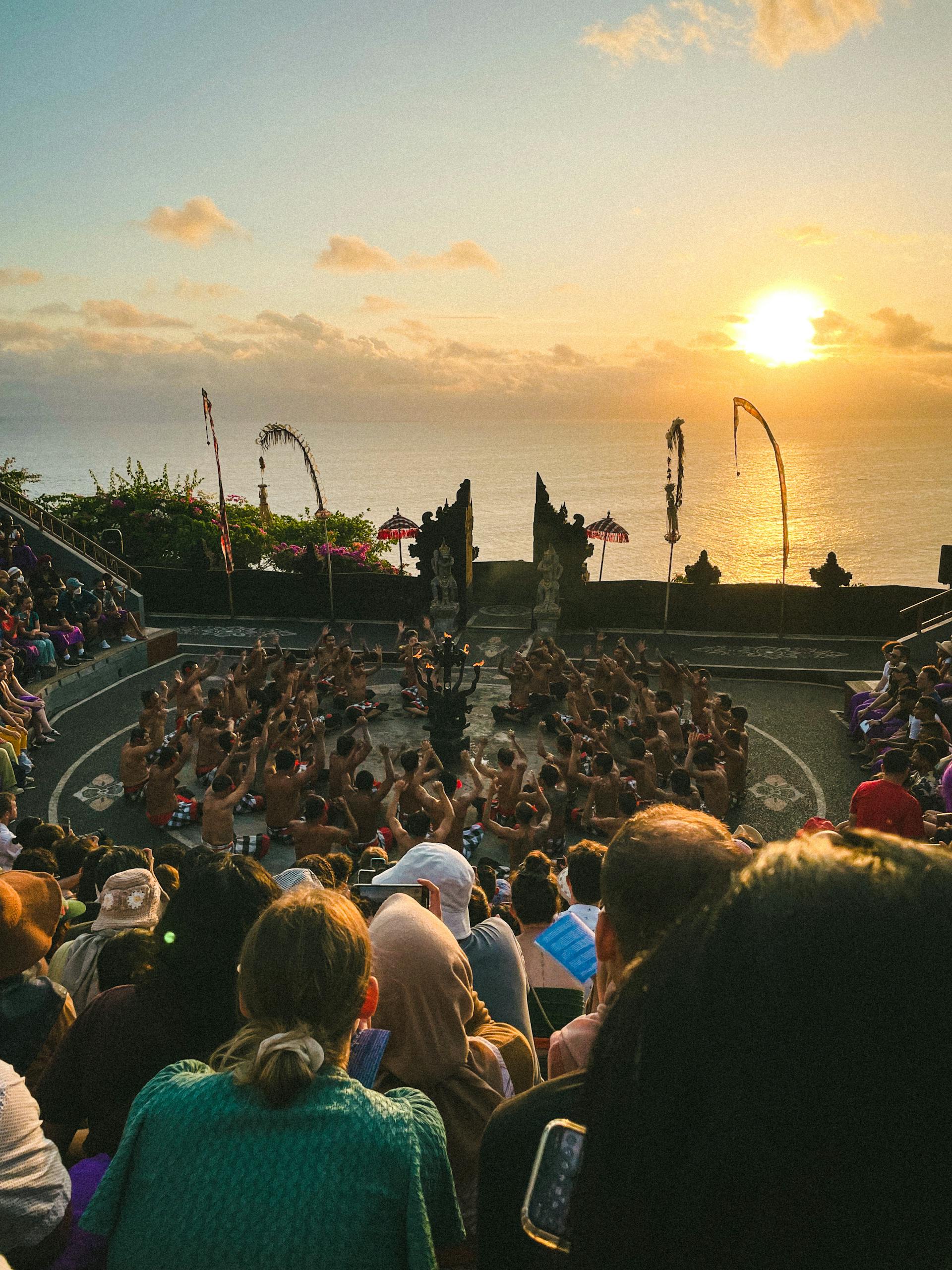
The 6pm Kecak performance at Uluwatu temple is a tourist staple for good reason: 50 to 70 men in a chanting circle, a fire-lit central performance area, the silhouette of the cliffside temple behind, and the Indian Ocean turning orange. It is the closest thing Bali has to live theatre with built-in special effects.
It runs around 90 minutes on hard stone-tiered seating. There is no interval. The chanting is rhythmic and loud but not painful — closer to a sustained low chorus than a shock. The fire section near the end involves a performer kicking burning coconut husks around the central circle; embers can scatter into the front rows.
Our honest take: kids 4 and over usually love it, particularly the fire bit. Kids 3 and under generally do not last; the seating is uncomfortable, the chanting can be unsettling once the novelty wears off at the 30-minute mark, and there is no easy exit from the middle rows. If you have a baby in a carrier who reliably falls asleep, you can swing it — sit in an aisle seat at the back. If you have a wriggly two-year-old, skip it this trip and come back when they are five.
Tickets are sold at the temple gate. The dance fills up fast in peak season; on busy weeks the temple opens a second seating area. Arriving at 5pm gives you the temple walk plus a good seat. Cash only, smaller notes preferred.
Surf school, swim school and the kid-friendly activities
The Bukit invented the modern Bali surf school. Most operators take kids from age 5, some from age 4 with a parent in the water alongside. The standard lesson is two hours, one-to-one or one-to-two coaching ratio, soft-top board, in waist-deep water at a beginner-friendly beach. The sweet spot for first-time surf kids on the Bukit is Padang Padang at low tide (when there is a sand-bottomed inside section) or one of the protected nooks on the eastern coast. Be honest with the school about your child's swimming ability — they will be honest back.
For non-surfers, the calmer water at Melasti and Karma Kandara is ideal for snorkelling-lite — goggles, a noodle, and parent supervision. Coral is patchy on the Bukit compared to Amed or Nusa Lembongan, so set expectations.
Off the beach, the Bukit does not have a Waterbom Bali equivalent. For waterpark and play-centre energy you will need to drive back toward Kuta or Nusa Dua, which is a 45-to-60-minute round trip plus the visit itself — a full day, not a half day. Build it into the schedule.
Drive logistics on the Bukit
This is where families get caught out. The Bukit Peninsula has one main artery — Jalan Raya Uluwatu — and almost everything branches off it. A morning at Melasti, lunch at a clifftop cafe near Padang Padang, and the Kecak dance at sunset sounds like a fine day. In practice it is three separate 20-to-35-minute drives plus parking faff, in heat, with kids who napped in the car and now will not nap at the villa.
Two practical rules. First, anchor each day to one zone — eastern Bukit (Melasti, Pandawa, Karma) or western Bukit (Padang Padang, temple, Single Fin sunset) — and resist the temptation to crisscross. Second, pre-book a driver for the day rather than chaining ride-hail apps. Ride-hail coverage on the Bukit is patchy, drivers refuse short runs, and a car seat is essentially never included.
From the airport, the Bukit transfer is typically 40 to 50 minutes in light traffic and up to 75 in heavy traffic. There is one toll-road section that helps; outside the toll it is single-lane each way. We always recommend pre-booking the airport transfer with a fitted car seat the moment your flights are confirmed — see our Bali airport to Uluwatu transfer page for car-seat options, ETAs and meet points. The first impression of your holiday should not be a meter-taxi argument at 11pm with a screaming toddler.
Food, heat and the daily rhythm
The Bukit's food scene splits cleanly into two tiers. The clifftop venues — Single Fin and its various imitators along the western coast — are extraordinary at sunset and aesthetically perfect, but the menus are generic Western-leaning and not especially child-friendly in execution. Single Fin in particular is an adult vibe in the evenings, especially on Wednesday and Sunday sundowner nights when the crowd skews young and loud. Brilliant for a parents-only kid-asleep-in-villa moment if you have a babysitter; not the move for a 5pm family dinner.
The unsung tier is the warung scene tucked off the main road, particularly around Pecatu and on the back streets near Ungasan. Nasi campur, mie goreng, satay, fresh juices — kid food in Bali is broadly simple, mild and easy to eat with fingers. Most warungs are happy to do plain rice and a fried egg for a fussy eater. Daily budget for a family of four eating warung lunches and one cafe dinner is genuinely modest; this is one of the reasons Bali still beats Australian holiday-park economics.
The climate question matters more on the Bukit than in Ubud. The plateau is exposed, dry and sun-saturated from about 10am to 3pm. There is almost no natural shade on most beaches. UPF rashies for the kids, a beach umbrella in the boot of the driver's car, mineral sunscreen reapplied every 90 minutes, and a rhythm that puts the kids back at the villa pool between roughly 11am and 3pm is the standard Bukit family day. Try to be sunset-side by 5pm — it is when the peninsula is at its best.
Health, water and the boring-but-important stuff
The Bukit does not have a major hospital on the peninsula itself. The closest serious facilities are in Kuta and Nusa Dua — BIMC Hospital Kuta and Siloam are the standard expat-grade options, both roughly 30 to 45 minutes from most Bukit villas depending on where you are staying. For minor issues (ear infections, gastro, the inevitable scraped knee), most villa managers can call a doctor to the villa. Carry your travel insurance details printed on paper, not just in an app — Bali wifi has opinions.
Do not drink the tap water and do not give it to kids to brush teeth with. Every villa supplies large refillable bottles; if you run out, the warung next door has them. Ice in established cafes and villa kitchens is safe; ice from a roadside cart is a gamble.
Mosquitoes are mild on the Bukit compared to inland Ubud — the breeze helps. A picaridin spray at dusk is enough for most families. Dengue exists in Bali but is uncommon in the Bukit area; standard precautions are sufficient.
Sample 4-day Uluwatu plan with kids under 6
Day 1 — settle in. Airport transfer with car seat (pre-booked). Late check-in, villa pool, early dinner at the villa or a nearby warung. Do not try to do anything else. Jet-lagged kids and unfamiliar geometry are a bad combination.
Day 2 — Melasti morning. On the sand by 9am, sunbeds and umbrella, swim, snacks, back to villa by midday. Pool and nap window 1pm to 3:30pm. Optional sunset drinks somewhere with a kids menu on the western cliffs — aim to be home by 7:30pm.
Day 3 — temple and dance day. Slow morning at the villa. Late lunch around 2pm. Driver collects 4:30pm, temple walk and monkey adventure 5pm, Kecak dance from 6pm (skip if your youngest is under 4 — do a clifftop dinner instead and watch the sunset). Home by 8pm, kids straight to bed.
Day 4 — splurge day. Karma Kandara beach club for the day, or a surf lesson for the 5-plus crowd while the younger sibling does villa pool with the other parent. Final dinner at the villa with the cook making nasi goreng. Pack tonight, not tomorrow morning — Bali airport transfers should leave with comfortable buffer.
FAQs
Is Uluwatu suitable for babies? Yes, with caveats. Choose a plateau villa over a multi-level cliff villa, use Melasti or Karma Kandara as your beach, keep baby in a carrier rather than a pram for any beach access, and book a transfer with an infant car seat for the airport run. The Bukit is breezy and less humid than inland Bali, which most babies tolerate well.
Can we use a pram in Uluwatu? Only at Melasti Beach and along the temple cliffside path, and even there a soft carrier is easier. Padang Padang, Bingin, Suluban and Nyang Nyang are not pram-accessible. Most villas have stepped terraces. If you have a baby in 2026, plan around a carrier as the primary mode of transport and bring the pram only if you also plan time in Sanur, Seminyak or Nusa Dua.
What about the monkeys at Uluwatu Temple? They are organised, fast and motivated. Do not bring sunglasses, loose water bottles, food, hats or anything dangling from a bag. Keep babies in a front-carrier where you can see them. Do not make eye contact or smile with teeth. Temple staff are well-practised at retrieving stolen items in exchange for fruit.
How long is the drive from Bali airport to Uluwatu? Plan 40 to 50 minutes in light traffic and up to 75 minutes in afternoon peak. There is a short toll section. Pre-book a transfer with a fitted car seat — meter taxis at the airport will not have one, and ride-hail apps have inconsistent coverage on the Bukit.
Do we need a pool fence at the villa? If you have a child under five, almost certainly yes. Bali villa pools rarely come with permanent fencing because it interrupts the design. Hire a freestanding pool fence for the duration of your stay — we cover this on our gear rental page along with cots, high chairs and stair gates.
Is the Kecak Fire Dance OK for toddlers? Not really. It runs 90 minutes on hard seating with loud rhythmic chanting and a fire performance at the end. Kids 4 and up usually love it; under-3s typically tap out at 30 minutes and there is no easy mid-row exit. Try again when they are older.
Where is the calmest beach for a toddler swim? Melasti Beach at mid-low tide, on the eastern Bukit. Paved road access, parking, sunbeds, shade for hire, and a sheltered reef-protected swim zone. Karma Kandara is the premium alternative if you are happy to spend on a day pass with food minimum.
Is there a waterpark on the Bukit? No. The big one is Waterbom Bali in Kuta, roughly 45 to 60 minutes north depending on traffic. Build it in as a full day trip rather than a half-day.
How long should we stay in Uluwatu? Three to five nights is the sweet spot for most families. Less than three and you spend more time settling in than enjoying; more than five and you will want a change of scene to Sanur, Ubud or one of the islands.
Can we combine Uluwatu with Ubud in one trip? Yes, and we recommend it. The drive between Uluwatu and Ubud is around 90 to 120 minutes depending on traffic. Most families do 4 nights Bukit then 3 nights Ubud, or vice versa, with a single mid-trip transfer in between.
Uluwatu rewards families who arrive with the right expectations — the right beach, the right villa, the right kit, and a driver who has done the school-run on the Bukit a thousand times. If that is the trip you are planning for 2026, pre-book your airport transfer and any onward Bukit driver days at balifamilytravels.com — fitted car seats, parents on the team, and the kind of advice in this guide built into every booking.
Book Uluwatu with a baby seat waiting: Our Uluwatu sunset tour includes a pre-booked Kecak aisle seat and your driver waiting with the ISOFIX seat fitted. All family tours →