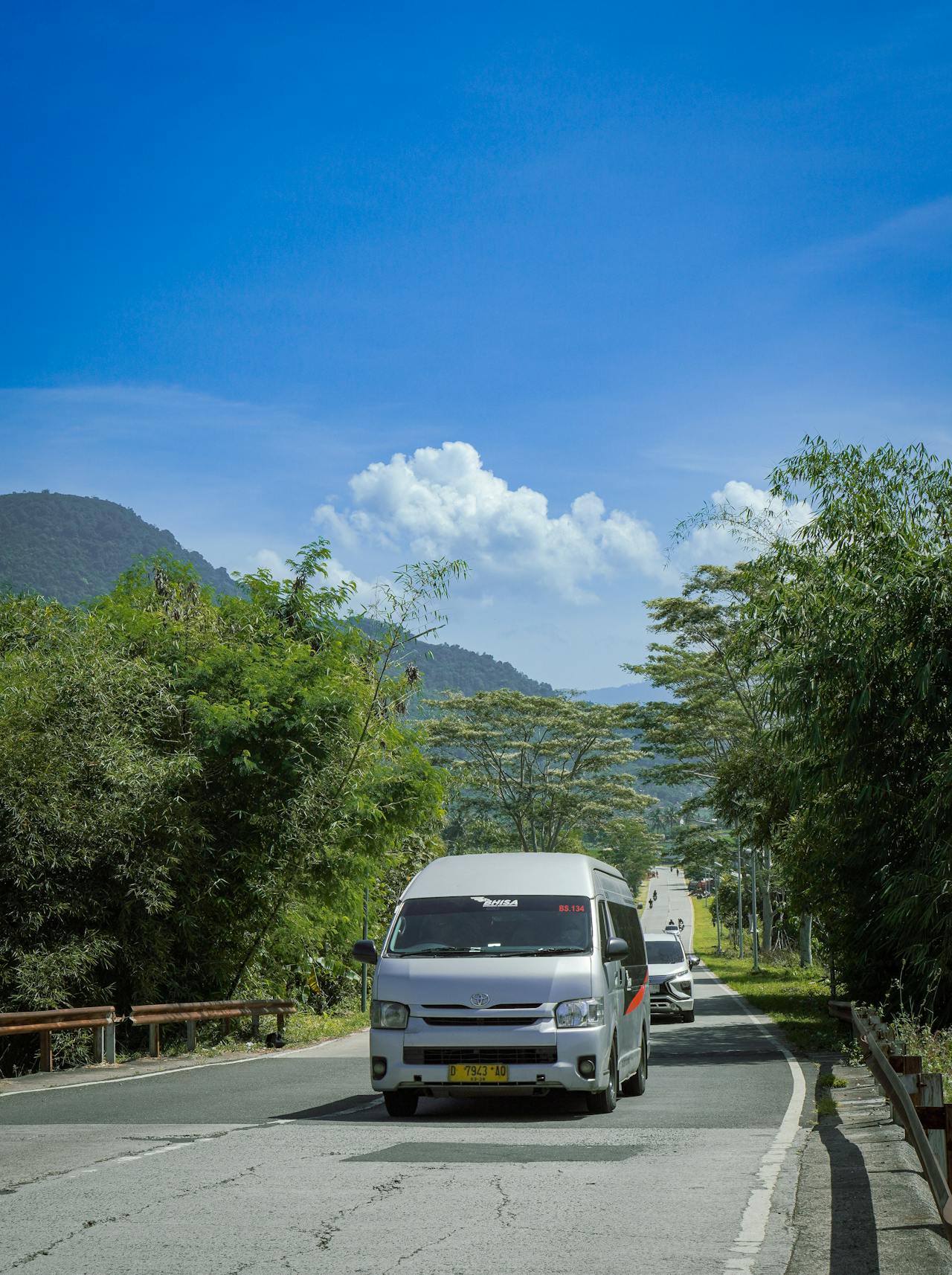
Will a Toyota HiAce Fit 3 Car Seats and Luggage? A Guide to Bali Minibuses
A practical breakdown of what actually fits inside a Toyota HiAce in Bali — three ISOFIX child seats, eight suitcases, two prams, and which configurations fail.
Last reviewed:
If you have ended up on this page, you are probably staring at a Bali villa booking for ten people, a flight schedule with two car seats and a booster, and a vague offer from a tour operator that mentions a "minibus" without ever showing you a photo. The honest answer is that a Toyota HiAce Commuter does comfortably fit three ISOFIX child seats and roughly eight large suitcases — but only if you book the right configuration, and only if the row layout has been confirmed at the time of booking. This is a parent-to-parent guide to what actually fits, what does not, and how to avoid the curb-side surprise where your booster is in your lap and a suitcase is on the floor between your feet.
What a HiAce actually is
The Toyota HiAce is the most common large passenger van in Indonesia. Locally, the version you most often see is the HiAce Commuter — an 11-seat configuration with two seats in the front cab, a three-seat row directly behind, then two more three-seat rows further back, and a deep luggage hold behind the last row. The seats slide and recline modestly. The roof is tall enough to stand up under in the cabin. The doors are a sliding kerb-side door and a rear hatch — no rear passenger door. This is the vehicle that does the airport-shuttle work for most Bali hotels, and it is the workhorse of our large-group transfers.
There are other HiAce variants in circulation. The HiAce Premio is a slightly more luxurious finish on the same chassis. The HiAce Super Long is a longer-wheelbase 14-seat option that is sometimes available but less common. The older HiAce KDH series is still on the road in Bali — comfortable but a bit dated, with cloth seats and less luggage space than the newer body. When you book a "HiAce" with us, you are getting a Commuter or Premio on the current body unless we tell you otherwise. The vehicle photos we send the day before your transfer will show you the exact vehicle.
Worth noting upfront: not every "minibus" in Bali is a HiAce. Some operators substitute an older Isuzu Elf, a Mitsubishi L300 (much smaller and less safe), or a converted commercial van with bench seating bolted in. If a booking site does not name the vehicle, assume the worst and ask. The brand and model matter.
The three-car-seat question, answered properly
Three child seats side-by-side in a single row is the constraint that breaks most Bali vehicles. The reason is structural: ISOFIX anchor points are bolted to the chassis, not the seat, and most three-seat rows have only two sets of anchors — at the outboard positions, not in the middle. So when an operator says "we can fit three car seats", they often mean "two ISOFIX seats and one seatbelt-installed seat", or "two seats in row two and one in row three", neither of which is what a parent of three young kids is asking for.
The HiAce Commuter we use is fitted with three ISOFIX positions in the row directly behind the front cab — outboard left, centre, outboard right. We had this specifically retrofitted because the multi-family demand from Australian and UK families wanted it. The row is also wide enough to fit three modern car seats side-by-side without overlap; many SUV middle seats are too narrow even when the anchor points exist. We have run this configuration with a Maxi-Cosi infant capsule, a Britax forward-facing toddler seat, and a high-back booster all installed simultaneously — and the row is comfortable, not crammed.
What does not work: trying to put four car seats in row two. The geometry simply does not support it. If you have four children all needing seats, the layout we use is three in row two (one infant capsule + two forward-facing) and one booster in row three with a regular seatbelt. The booster in row three is perfectly safe — high-back boosters are belt-positioning devices that do not need ISOFIX — but it does separate that child from the parents up front. We typically put the oldest child in the row-three booster and the youngest closest to the parents.
For a family with two car seats and a booster (the most common multi-family configuration), all three can go in row two, side-by-side, with parents in the front cab and any older kids or grandparents in row three. This is the layout that works for two families with one toddler each and an older sibling.
The eight-suitcases question, with measurements
The HiAce has a deep luggage hold behind the rearmost passenger row. Floor-to-ceiling height is roughly 80–90 cm in the hold, depth from the rear hatch to the back of the rear seats is about 70–80 cm, and width is the full vehicle width minus wheel arches, around 130 cm. That is enough for a stack of large suitcases two-high if you load carefully.
In practical terms, eight large checked suitcases (the typical 73 cm × 50 cm × 30 cm size that fits a Jetstar checked-bag allowance) fit comfortably stacked two-high. A ninth might fit at a squeeze. Anything beyond that and you are stacking into the rear passenger row, which is fine if the back row is empty but obviously a problem with eleven people on board.
Carry-on bags ride on passengers' laps or in the under-seat space. There is no overhead storage — this is not a coach. For a family of eleven with eight large bags and eleven carry-ons, the luggage capacity is comfortable but not infinite. Plan around it.
Where the maths gets interesting is with prams. A modern travel pram (umbrella stroller, City Mini, or Babyzen YoYo) folds flat and stores upright against the side of the luggage hold without taking a full suitcase slot. A full-size pram (Bugaboo, UPPAbaby Vista with bassinet, or any larger model) is closer to a suitcase in volume — count it as one suitcase slot. Two large prams plus eight suitcases is the realistic upper limit before we recommend a small luggage support vehicle behind.
Tip from experience: ask each family to consolidate into the largest checked bags their airline allows, rather than splitting into many small bags. Eight large suitcases stack more neatly than fifteen medium duffels, and the loading time at the airport is dramatically shorter.
Walk-through cabin: why it matters with babies
The HiAce Commuter has a walk-through corridor on the kerb side, between the sliding door and the back of the cabin. This means a parent can move from row two to row three (or back to the front cab) mid-trip without unbuckling from a seat or asking the driver to stop. With a sleeping baby in row two and an awake toddler in row three needing snacks, this is genuinely useful — far more useful than it sounds when you read it on a brochure.
Compare with a typical three-row MPV (Innova, Stargazer), where you have to climb over a tilting middle seat to reach the back row. With a baby in the middle, that climb wakes the baby every single time. With a HiAce, you stand up, walk down the corridor, hand over the snack, and walk back. The structural difference is what makes the HiAce the right vehicle for multi-family transfers, not just the seat count.
The same corridor helps at loading and unloading time. With eleven people getting in and out at the villa gate, a single sliding door bottleneck is brutal. The HiAce lets one parent enter from the side door while another exits from the rear hatch, and the queue clears quickly. We have done a full unload of eleven people, eight suitcases and two prams at a Seminyak villa in under five minutes. That is not possible with two SUVs at the same kerb.
Air conditioning and the back-row problem
A common complaint about Bali minibuses is that the back row is hot. The driver runs the front A/C, the kids in the back row sweat for the entire 90-minute drive, and somebody arrives sick. The HiAce Commuter solves this with a dedicated rear A/C unit with its own blower, controllable from a switch in the cabin. We run the rear unit at the same intensity as the front for all family transfers. The temperature differential front-to-back is typically less than two degrees.
One small thing parents appreciate: the rear A/C means you can run the cabin slightly cooler than the front cab, which is what a sleeping baby needs. Without rear A/C, the back row is always warmer than the front, and the temperature you set in the cab is not the temperature your baby is experiencing. We have heard the same complaint enough times to know it is worth pointing out.
USB charging is in row two and row three — useful for tired phones after a long-haul flight when families have not yet sorted local SIM cards.
Safety, road behaviour and the things parents worry about
The HiAce is taller and heavier than an SUV, which has real implications for how it handles. The centre of gravity is higher, so it leans more in corners. The braking distance is longer. The wheelbase is longer, which means fewer scary lurches but also wider turning circles on Bali back lanes. None of this matters if the driver is good — and our HiAce drivers are specifically the ones with the most large-vehicle experience in our team. They drive the HiAce gently because it is a HiAce, not because they are being told to.
Modern HiAce Commuters come with ABS, traction control, and driver and passenger airbags. Side airbags are standard on the Premio variant and optional on the Commuter — we specify the Premio safety package when we can. The rearmost row has lap-and-shoulder seatbelts (not just lap belts), which matters for older kids on boosters. Front-facing booster seats use the vehicle's three-point belt; we check the belt geometry on the booster row at every install.
Road behaviour on the Bali bypass at night is the most common time families notice a HiAce ride. The vehicle handles potholes more gracefully than an SUV because of its weight and longer wheelbase, but it pitches more on the speed bumps that punctuate every Bali back lane. A driver who is experienced with the HiAce will slow noticeably for bumps and corners — if your driver is gunning it on the Sunset Road, message us and we will speak to him.
The Isuzu Elf and other "minibus" substitutions
Some Bali operators offer an "Isuzu Elf microbus" for large groups. The Elf is a different beast — it is a 16–20 seat light truck conversion, much more common in tour and shuttle work than family transfer. The bench seats are generally not ISOFIX-compatible, the suspension is firmer (it is a truck chassis), and the cabin is louder. We do not run Elfs for family transfers because they are not designed for car seats. If an operator quotes you an Elf for a multi-family booking, ask specifically about ISOFIX. The honest answer will be "no". The dishonest answer is "yes, we can fit seatbelt-installed seats" — which means lap-belt seats, which are not what you want.
Other substitutions to watch for: Mitsubishi L300 (smaller, older, less safe than a HiAce); Suzuki APV (essentially a stretched van — fine for short trips, tight for a multi-family with luggage); and unbadged converted commercial vans with bench seating and no ISOFIX provision at all. None of these are the vehicle a multi-family group with babies wants.
When you book a HiAce with us, you get a HiAce. Photo and plate sent the day before. No substitutions without your explicit consent. This is the kind of operational detail that sounds boring until you are standing at the airport at midnight looking at a vehicle you did not book.
Real configurations we see most often
To make this concrete, here are the configurations we see most often on real bookings, and how the HiAce loads up for each.
Two families, four kids under 6 (8 passengers). Row two: two infant capsules and one toddler seat. Row three: one parent and the booster-aged child (or one parent and the eldest sibling without a seat). Row four / boot: nappy bag accessible, prams folded. Front cab: driver plus one parent. Luggage hold: six large suitcases, two prams stacked. Comfortable, fast to load, kids stay together with their respective parents.
Multi-generational, one toddler, one booster (9 passengers). Row two: toddler seat in centre ISOFIX, parents either side. Row three: grandparents (easier access via walk-through). Row four: older sibling on booster. Front cab: driver plus one parent. Luggage hold: five large suitcases, one full-size pram. Grandparents are in the easiest-access row, the toddler is reachable by both parents, the older kid is in their own zone.
Friend group, four couples, three toddlers (11 passengers). Row two: three forward-facing toddler seats side-by-side. Row three: three parents (one per kid). Row four: three more adults. Front cab: driver plus one adult. Luggage hold: eight suitcases, two travel prams. This is the upper-density configuration where loading takes ten minutes and unloading takes ten minutes — but it works.
Australian school holiday, two families, late-night arrival (10 passengers). Row two: two car seats and one booster. Row three: two parents. Row four: three older kids. Front cab: driver plus one parent. The walk-through corridor matters here because the kids in row four invariably need water / snacks / a parent for the entire drive.
What to tell us when you book a HiAce
To get the right vehicle and configuration, the booking information that matters most is: total passenger count, ages of every child under 12 (we map each to a seat type), number of large checked suitcases (rough is fine), number of prams and whether they are travel or full-size, any mobility considerations, and any flight number(s) so we can track arrivals. Tell us at booking, not at the airport.
One thing that often surprises us: families forget to mention a teenager who is technically still child-seat age (under 12, under 135 cm). They assume the kid is "big enough not to need a seat", and then we arrive with a booster they did not want. Always mention every child under 12. We err on the side of installing the seat — if you do not need it, the driver removes it in 30 seconds. The reverse (needing a seat we did not bring) is a much worse problem.
If you have specific car seats you want to use from home — for example, a Maxi-Cosi i-Size that you have already paid for — bring them and the driver will install them on top of (or instead of) our seats at no extra cost. Many Australian families do this because their child is used to a specific seat and the routine helps with jet-lag and travel stress.
FAQs
Can you fit three ISOFIX car seats in one HiAce? Yes, side-by-side in the row directly behind the driver. This is the configuration we use for multi-family transfers and it is the main reason we send the HiAce for groups of seven or more. See our large-group transfers page for full vehicle specs.
How many large suitcases fit in a HiAce? Roughly eight large checked suitcases (Jetstar / Virgin checked-bag size) in the rear hold, stacked two-high. Plus carry-ons on laps or under seats. Plus one or two prams stored upright. For groups at the upper luggage limit, we sometimes add a small luggage support vehicle.
Is there enough A/C in the back of the HiAce? Yes — there is a dedicated rear A/C unit with its own blower controllable from the cabin. The front-to-back temperature differential is small. Sleeping babies in row two stay cool.
Can a parent move from the front to the back of the HiAce during the drive? Yes — there is a walk-through corridor on the kerb side. Useful for handing snacks back, settling a toddler in row three, or moving to the front cab during the drive. Far more useful than the same trip in a typical MPV where you have to climb over a seat.
How do you confirm we are actually getting a HiAce and not a substitute? We send a WhatsApp message the day before with the driver's name and photo, plus a photo of the actual vehicle with the licence plate visible. No substitutions without your explicit consent.
What if our group has more than 11 people? We dispatch a coordinated convoy of two vehicles — typically a HiAce plus a Premium MPV — with one lead driver as your point of contact and both vehicles in the same arrival window. See our large-group transfers page for the convoy logistics.
Can we use the same HiAce for day trips during our stay? Yes — we offer the same vehicle and driver on a private-driver day rate. Many groups book the airport transfer plus several day-trips together for continuity.
The short version of this entire article is: yes, the Toyota HiAce Commuter genuinely fits three ISOFIX car seats and roughly eight large suitcases, with room for prams and a walk-through corridor that makes the difference between a calm airport transfer and a chaotic one. The longer version, which is what you have just read, is that the details matter — the specific row layout, the A/C, the type of pram, the loading order — and an operator who cannot give you a confident answer on each of these is not the operator you want when your flight lands at midnight with eleven tired family members and nowhere else to go. Pre-book a HiAce on balifamilytravels.com and we will look after the rest.