Pool Fence Hire in Bali 2026: An Honest Guide for Aussie Parents
Why most Bali villas have no pool fence, what removable fence hire actually looks like, and the brutally honest safety conversation no one back home is having.
Last reviewed:
If you have a toddler and you are booking a Bali villa for 2026, there is one thing your accommodation listing almost certainly will not mention, and it is the single biggest safety adjustment Australian, Kiwi and British parents make on arrival. The vast majority of Bali villas have no pool fence, no self-closing gate, no isolation barrier of any kind — and Indonesia has no equivalent of the AU Building Code rules we have grown up assuming are universal. The pool is usually right there, open to the living room, often at the edge of a terrace, and your two-year-old can walk straight into it. This guide is the parent-to-parent briefing we give every family who books a transfer with us and mentions they are travelling with under-fives. We will cover why the gap exists, what removable pool fences in Bali actually look like, how the hire process works, what it costs, and — most importantly — the safety conversation that does not get had often enough.
Why Bali Villas Almost Never Have a Pool Fence
This catches almost every Australian family off guard, so it is worth understanding why. Australia, New Zealand and the UK all have legally mandated pool fencing requirements built into building codes. In Australia, every backyard pool must be surrounded by a compliant barrier with a self-closing, self-latching gate. Most of us have grown up assuming a fenced pool is just what a pool is. Indonesia has no equivalent national law. There is no inspector who signs off a villa pool. There is no fine for not having a fence. It simply is not part of the regulatory or cultural framework.
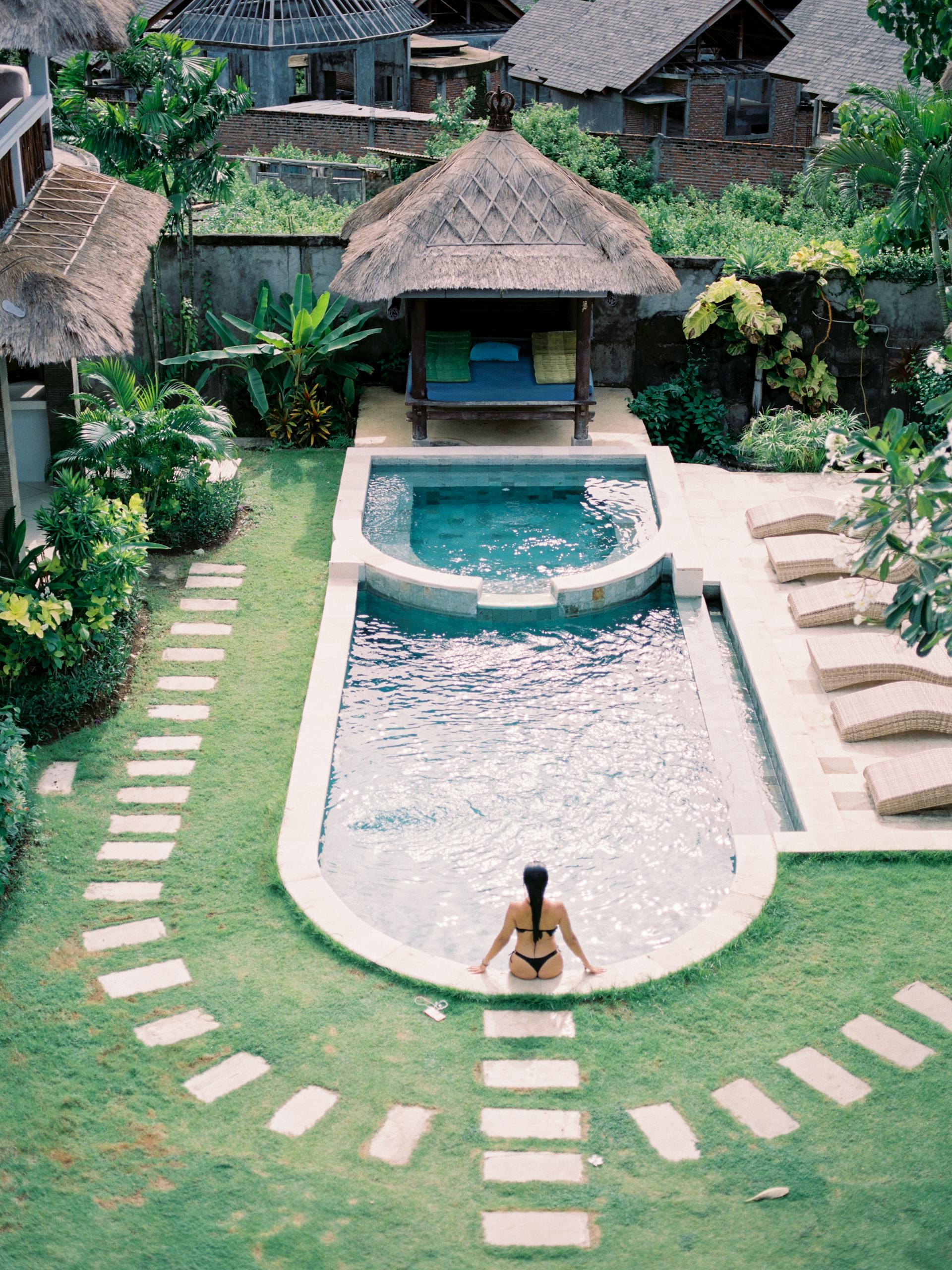
On top of that, Bali villa design is built around the opposite aesthetic — the pool is meant to be the centrepiece, flowing visually into the living pavilion, framed by frangipani and timber decking, with no visible barrier between you and the water. Owners deliberately design pools to be seen, photographed and Instagrammed. A pool fence would, from a design and marketing perspective, ruin the very thing they are selling. So even brand-new luxury villas built in 2026 are usually fence-free unless the owner is a parent themselves or has been specifically asked by previous guests.
The result is a mismatch you need to plan for. At home you essentially cannot let your toddler near the pool area unsupervised because the fence stops them. In Bali, the same toddler can be in the water in under ten seconds from the bedroom door, the kitchen, or the path to the bathroom. It is not the villa's fault, it is not your fault — it is just the gap between two regulatory systems, and you are the one who has to bridge it.
The Real Risk: Why This Matters More Than You Think
Drowning is the leading cause of unintentional death for children under five in Australia, and the pattern is consistent across the UK and New Zealand. It is also fast and silent — nothing like the splashing and shouting you see in films. A toddler in difficulty typically goes under in seconds, with no noise, no waving, and no obvious distress signal. Adults nearby routinely fail to notice until it is too late, even at a poolside birthday party with twenty people present.
Bali amplifies several risk factors in ways most parents do not anticipate. Infinity pools have an edge that does not give your child a visible wall to grab. Plunge pools are often built right against terrace edges with no perimeter walkway. Multi-level villas mean a toddler can wander off a mezzanine balcony, down stairs and into the pool without crossing a single door. Many villas have separate kids' bedrooms across an internal courtyard from the parents' room — at home, that would never include an open body of water in between. And the holiday brain that lets you finally exhale also lowers the constant background vigilance every parent of a small child unconsciously runs at home.
We are not trying to scare anyone out of bringing their kids to Bali — we have brought our own and we run a business built around family travel. But the conversation about pool safety in Bali is too often skipped or softened, and the honest version is that the risk is real, it is well-documented, and it is preventable with very modest effort and cost. A removable pool fence plus active adult supervision is the gold standard, and both layers matter.
What a Removable Pool Fence in Bali Actually Looks Like
The product the Bali rental market has standardised around is a modular mesh fence, usually around 1.2 metres tall, made up of panels roughly 2.4 to 3 metres wide. Each panel is a fine black or white polyester mesh stretched on an aluminium frame. The mesh is fine enough that small fingers and toes cannot get a foothold to climb, but transparent enough that you can still see the pool through it. From inside the villa, it largely disappears against the deck — far less visually intrusive than the chunky glass panels you see in Australian backyards.
There are two main installation methods, and which one applies depends on your villa's deck. The first is the drilled-sleeve method, where the installer drills small holes into the pool deck and inserts permanent plastic sleeves, then the fence stakes drop into the sleeves. The holes are about the diameter of a pencil, and when the fence comes out, the sleeves get capped flush — barely noticeable. The second is the weighted-base method, where heavy flat bases sit on top of tile or polished concrete and hold the uprights, no drilling required. This is what most short-term villa rentals use because the owner does not want anyone drilling their feature deck.
Either system includes at least one self-closing, self-latching gate panel — usually positioned at the shallow end or wherever access from the villa is most natural. The gate latch sits high enough that a toddler cannot reach it, and the gate swings closed under tension. Combined, the panels create a continuous barrier all the way around the pool, with the gate as the only deliberate point of entry. It is exactly the same logic as an Australian backyard pool barrier, just designed to be portable.
How the Hire Process Works
The process is genuinely simple, and one of the reasons we built it into our gear-rental service alongside cots, car seats and prams. You tell us the villa name, the approximate length of the pool perimeter, and your check-in and check-out dates. We coordinate with the fence provider, who liaises with the villa staff to confirm deck type and access. On the day you arrive, an installer turns up either ahead of you or shortly after check-in, and sets the fence up in about 30 to 60 minutes for a typical villa pool. They walk you through how the gate latches, hand you a small wrench in case any panel needs tightening, and that is it. On your departure day, they come back and take it down.
Two practical notes. First, the perimeter length matters because that determines how many panels are needed, and pricing usually scales with linear metres. A small plunge pool might only need three or four panels. A long lap pool can need eight to twelve. Second, gates need a small clear run on the inside, so if your villa has loungers or a sunbed jammed right against the pool edge, the installer will rearrange furniture during setup. None of this is your problem to manage — but it helps to know what to expect when the installer arrives.
Lead time is the one thing parents do underestimate. The installers in Bali are a small group serving a growing market, and during the AU and NZ school holiday peaks — June/July, late September, the Christmas/January window, and Easter — they get booked out a week or two ahead. If you are travelling in peak, organise the fence at the same time you confirm the villa, not after you land.
What It Costs, and Whether It Is Worth It
Across the main Bali providers, removable pool fence hire typically runs in the range of AUD 15 to 25 per day, with some variation based on pool size, location of the villa, and length of stay. Long-stay families on a one or two-week booking sometimes get a slightly better daily rate; very remote villas in north Bali or the Bukit can attract a small delivery surcharge because the installers are based around Seminyak, Canggu and Sanur. There is usually a setup-and-takedown fee on top, often AUD 50 to 80 depending on the provider and the distance.
For a typical Australian family staying ten days in a Canggu or Seminyak villa with a 25-square-metre pool, you are looking at somewhere in the range of AUD 200 to 350 for the full hire, all in. We will not pretend that is nothing. But set it against what you already spent on flights and the villa, and compare it to the price of any other piece of safety gear you would buy at home — a decent car seat, a baby monitor, a stair gate — and it sits comfortably in the same bracket. We have never had a parent tell us, after the trip, that they regretted the spend.
If budget is genuinely tight and you are weighing the fence against other gear, our honest priority order for under-fives travelling to Bali is: a properly fitted ISOFIX car seat for the airport transfer and any day trips, a pool fence if your villa has an open pool, and a travel cot. Everything else — high chair, pram, baby bath — is a comfort item. The fence and the car seat are the two that actually shift the risk profile.
The Real Safety Message: A Fence Is One Layer, Not a Substitute
This is the part of the conversation that gets glossed over, and we are going to be blunt about it. A pool fence is a layer of protection. It is not a babysitter, and it does not let you stop watching your child. Every drowning prevention guideline published by Royal Life Saving Australia, Water Safety NZ and the equivalents in the UK uses the same model: layers of protection — barriers, supervision, swimming competence, resuscitation skills — stacked on top of each other, because any single layer can fail.
The single most important rule for toddlers under five in Bali, fence or no fence, is the arm's-reach rule. When your child is in or near the water, one designated adult is within arm's reach. Not "watching from the lounger." Not "watching while making a smoothie." Within arm's reach. If you and your partner both want to swim, one of you is on the child. If you want to read a book, the child is out of the pool area entirely with the gate latched. This sounds intense, and on a holiday it feels disproportionate, but the data on toddler drowning is unambiguous: the moments where it happens are almost always the moments the responsible adult thought another adult was watching, or looked away for "just a second."
The fence is what protects your child during the inevitable lapses — the bathroom break, the bag retrieval, the phone call, the bedtime when you assumed they were asleep. It catches the human error. But the active supervision is what protects them when the pool is in use, and there is no fence on the market that replaces it.
Other Pool Safety Considerations for Bali Villas
A fence is the big one, but a few other Bali-specific things are worth knowing. Many villa pools have a shallow end of around 30 to 50 cm, which is great for toddlers — but a surprising number drop straight to 1.5 metres or more with no gradient. Ask the villa for pool depths before you book if you have non-swimmers. Where possible, pick a villa with a proper shallow end with a step or shelf rather than a uniform-depth lap pool.
Pool decks in Bali are often beautiful polished stone or large-format porcelain tile, and when they are wet they can be slippery. The same applies to the floor outside outdoor showers, which is where toddlers tend to run after a swim. Walking shoes off, no running, is a rule worth reinforcing on day one. Some villas have proper non-slip tile in shower and pool-edge areas; many do not, and you simply have to be aware. A pair of reef shoes or cheap rubber sandals for older toddlers helps.
Pool alarms — the surface-disturbance sensors common in some American pools — are essentially unheard of in Bali. Do not plan around them. If your villa has one, treat it as a bonus. If it does not, you have not lost anything you were going to have.
And one last thing about heat: Bali sun is genuinely strong, and a shaded section of pool is a real asset for babies and toddlers. Most villa pools sit in full sun for most of the day, with a small shaded patch at one end during morning or evening. Plan swim times around that shaded section, and bring a UPF rashie and a wide-brim sun hat that stays on. Sunscreen alone does not cut it for under-twos in tropical sun.
Inflatable Arm Bands Are Not Safety Devices — A Hard Conversation
This is the part of the guide that annoys some parents, and we will say it anyway because it matters. Inflatable arm bands (the orange ring-style "floaties"), inflatable rings, swim seats and pool noodles are not safety devices. They are toys. They are not certified for life-saving use, they deflate, they slip off small arms, they flip toddlers face-down, and they give parents a dangerous sense of security that the child is "safe in the water" when they are not. Royal Life Saving Australia is explicit about this and has been for years.
A child who can swim is the safest child. A child who cannot swim and is wearing arm bands is not a swimming child — they are a non-swimming child whose face is currently above water, conditionally on a piece of plastic functioning correctly. If the bands slip, the child has no swimming response trained in, because every prior pool experience has felt secure. The bands have actively interfered with the development of the skill they need.
If you genuinely need a flotation aid — for example, on a boat to Nusa Penida or the Gili Islands — use a Coast Guard or AS-certified child life jacket with a head support and a crotch strap. Those are real safety devices, designed and tested to keep a non-swimming child face-up in water. Bring one from home if you can; rentals on the fast boats are inconsistent. For pool use specifically, the honest advice is: do not rely on flotation at all, keep the child within arm's reach, and use the fence as the backstop.
The Absurd Toddler Escape Stories We Hear
Every parent of a toddler will recognise this category. The kid who learned to open the bedroom door at 18 months. The kid who figured out a sliding glass door handle in 90 seconds flat. The kid who climbed the cot rail at 14 months and was found on the staircase. The kid who pulled a chair across the kitchen to reach a locked cabinet. Toddlers are tiny, single-minded engineers, and their full-time job is finding the limits of every barrier you put between them and what they want.
Bali villas are full of doors, handles and latches your child has never seen before. The handle on the master bathroom may push down. The villa side gate may have a slide bolt at toddler height. The pool deck access may be a sliding screen door with no lock at all. We have heard hundreds of stories from families who, in the first 24 hours, watched their two-year-old solve a door system the parents themselves had not noticed. One mum told us her daughter unlatched a French door, walked across the courtyard and stood at the edge of the pool — in pyjamas, at 6am, while both parents were still asleep — and only the fact that the dad happened to wake up and look out the window stopped it being a story with a different ending.
The point is not to terrify you. The point is that you cannot rely on the villa's interior doors to keep your child away from the pool, because you do not know which ones they will defeat or in what order. The fence is the last line. Make sure the last line exists.
Combining Pool Fence Hire With Your Transfer Booking
The reason we built fence hire into our gear-rental service is that the families we drive from the airport are overwhelmingly the same families who need it, and the logistical cost of coordinating multiple suppliers in your first 48 hours in Bali — jet-lagged, with kids, on patchy SIM signal — is genuinely high. When you book a transfer with us, you can add a pool fence, an ISOFIX child seat for the drive, a travel cot, a high chair and a pram on the same booking. Everything is delivered and installed at the villa by the time you finish your welcome drink.
The other reason to bundle is that we already know the villa neighbourhoods, the access roads, and which compounds have tricky entrances for delivery vans. We can tell the fence installer whether your villa lane in Pererenan needs a smaller vehicle, whether the staff at your Uluwatu cliff villa will accept delivery before guest check-in, and whether your Sanur compound has the kind of polished deck that needs the weighted-base system rather than the drilled sleeves.
If you want to combine fence hire with a transfer from Denpasar (DPS) to your villa — and an ISOFIX seat for the kids on the drive — the simplest approach is to book a transfer through balifamilytravels.com and add the fence at the same time. We will quote the fence component based on your villa pool size, confirm with the installer, and confirm both bookings together.
FAQs
How long does a pool fence install take? A standard install at a typical villa pool runs 30 to 60 minutes from arrival. Larger pools or villas with awkward deck access can take up to 90 minutes. Takedown on departure day is usually 20 to 30 minutes.
Will the installer drill into the villa's pool deck? Only if the villa owner has explicitly authorised it. For short-term rentals, almost all installs use the weighted-base system that sits on top of the tile or stone, no drilling. The fence provider confirms this directly with villa management before your arrival.
How tall are the fences and can a toddler climb them? Standard panels are around 1.2 metres tall, the same height required by Australian backyard pool fence laws. The mesh is designed without footholds. They are not climb-proof against a determined older child, but for under-fives they function as a proper barrier.
What if my villa already has a fence — do I still need to hire one? Check the fence carefully on arrival. Many villa "fences" are decorative — short timber rails with gaps, low glass panels with a manual gate that does not self-close, or barriers that only run along one side of the pool. If it is not a continuous 1.2-metre barrier with a self-closing, self-latching gate, treat it as decorative and consider hiring a real one.
Can I hire a fence for just a few days of a longer stay? Yes, most providers will quote any length from two or three days upwards. Many families on a two or three-week stay only hire the fence for the days they have toddlers in the villa, or for the days the older kids are not swimming under adult supervision.
Do you provide child life jackets as well? We can include certified child life jackets in your gear rental for boat days to Nusa Penida or the Gili Islands. We do not provide arm bands or inflatables, because they are not safety devices.
Is a pool fence necessary if my child can already swim? Swimming ability massively reduces drowning risk but does not eliminate it. For a confident swimmer aged six or older, the fence becomes less critical. For under-fives — even those who have had lessons and look like they can swim — fence plus supervision remains the recommended standard.
What if the villa owner refuses to allow a fence install? This is rare but happens, usually at high-end design villas. If you have already paid for the villa, your options are to negotiate hard, ask whether the weighted-base (no-drill) system would be acceptable, or — in extreme cases — change villas. When you tell us your villa name before booking the transfer, we can flag known refuser properties so you avoid the surprise.
Are there any villas in Bali that come with a proper pool fence already? A small but growing number of family-focused villas, especially in Sanur, Berawa and Pererenan, are now built with permanent pool fencing or offer in-house removable fencing as part of the booking. If you specifically want this, search for "family villa Bali pool fence" and filter — and confirm in writing with the villa before you pay.
Does Bali Family Travels handle the whole booking — fence, transfer, car seats? Yes. That is the whole point of the gear-rental bundle. One booking, one contact, one delivery window, everything installed by the time you sit down for the first time at the villa.
The villa pool is the centrepiece of almost every Bali family holiday, and with one removable fence, one honest conversation about supervision, and a couple of small adjustments to how you set up the first day, it can be exactly the relaxing, sun-drenched experience you booked it for. If you are planning a 2026 trip and want a pool fence, ISOFIX car seats for the airport transfer, and the rest of the gear sorted in a single booking, have a look at our gear-rental service or pre-book your transfer at balifamilytravels.com — we will handle the logistics so you can spend the first afternoon in the pool with your kids, not on the phone to suppliers.