Nusa Penida with a Baby: An Honest Family Guide (2026)
A parent-to-parent breakdown of what actually works on Nusa Penida with a baby or toddler — the boat, the stairs, the heat, and what to skip.
Last reviewed:
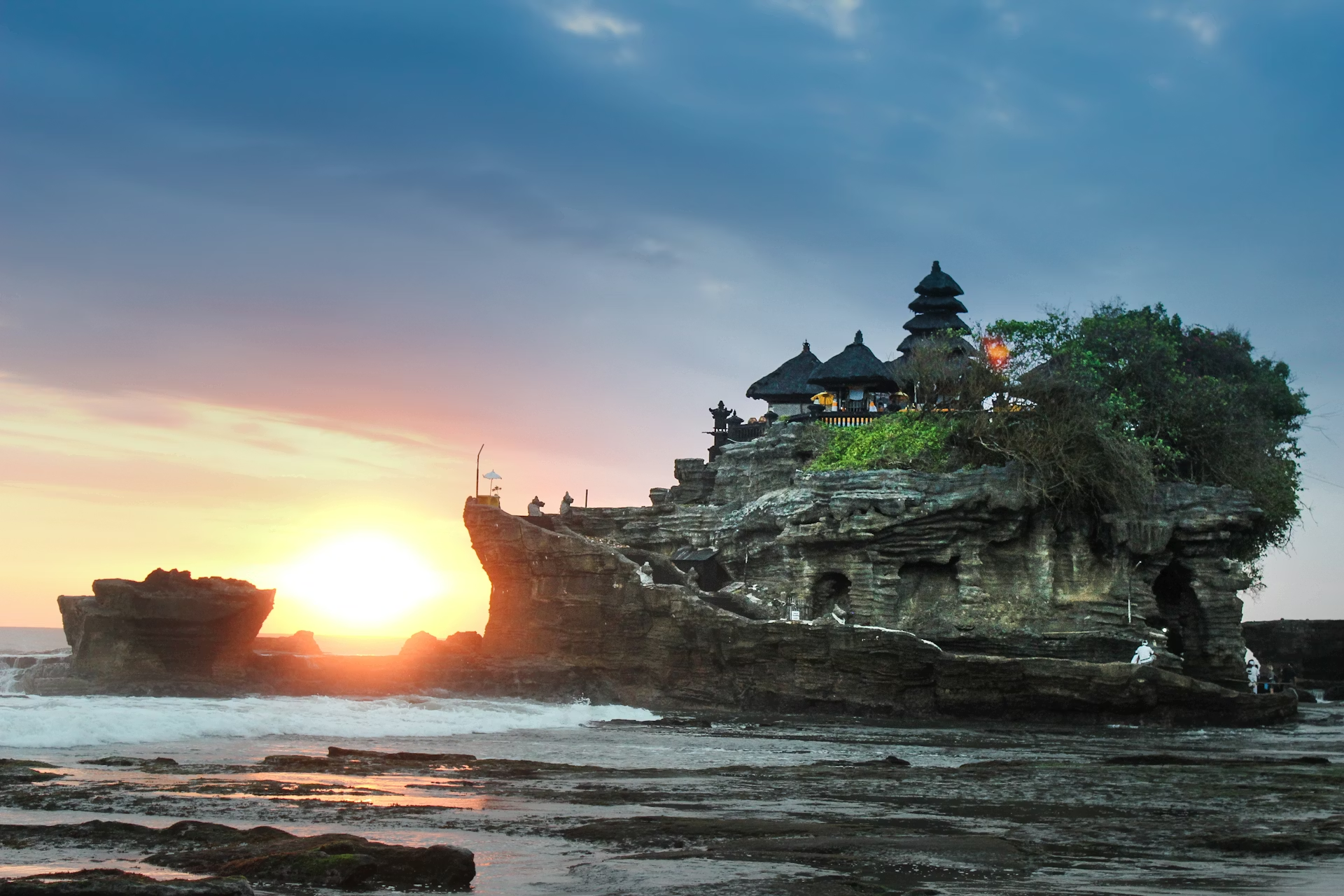
Nusa Penida looks unreal on Instagram, and that's exactly the problem when you're travelling with a baby. The cliffs are dramatic because they're steep. The viewpoints are stunning because they're hard to reach. Most of Nusa Penida's headline beaches are not toddler-friendly, and pretending otherwise leads to ruined days, hurt knees and a baby with heatstroke by lunchtime. This is our honest 2026 guide to doing Nusa Penida as a family with an under-3, written for the parents who've already googled "is Kelingking Beach safe with a baby?" and got a hundred conflicting answers.
The short version: should you even go?
If your child is under 18 months, we'd gently push you towards Nusa Lembongan instead. It's the smaller, calmer sister island — flatter, with mangroves, gentle beaches, beach clubs that take prams, and a 30-minute crossing on a similar fast boat. You can still see Nusa Penida's coastline from Lembongan on a sunset boat ride without ever putting a baby on those clifftop stairs.
If your child is 2 to 4, Nusa Penida works if you accept it as a one-stop day trip. Pick one viewpoint or one beach. Not a "west loop." Not "Kelingking plus Broken Beach plus Crystal Bay." One. Babies, heat, rough roads and unfenced cliffs do not combine with an ambitious itinerary.
If your child is 5+ and confident on uneven stairs, you've got real options. They still won't make it down all 700+ steps to Kelingking, but they'll handle Crystal Bay, the Broken Beach loop, and the easier viewpoints without you having to carry them up a cliff face in 34-degree heat.
Sanur to Nusa Penida: the fast boat with a baby
Almost every family does the crossing from Sanur. The fast boats leave from a beach launch — there's no proper jetty, no ramp, no gangway. Staff wade into the surf to lift bags and passengers onto a small boarding platform on the bow. With a baby in arms and a nappy bag on your back, this is the most stressful 90 seconds of the day. Go barefoot, roll your pants up, and let a crew member take your bag first so you have both hands for the baby.
Crossing time is 30 to 45 minutes depending on the operator and the swell. Morning crossings (the 7:30–9:00 boats) are almost always smoother than afternoon returns, when the wind picks up across the Badung Strait and the chop gets serious. If you can only do one direction in calm water, make it the return — a tired, seasick baby on a bouncing boat is a different category of misery.
On life jackets: every operator we've used hands out adult jackets at the dock. Infant and toddler jackets are not guaranteed. Some boats have one or two child sizes onboard; some have none. We strongly recommend either bringing your own infant PFD from home or hiring one in Sanur before you board. If you're flying with Jetstar or Virgin Australia from Australia, a soft infant life vest packs flat in a carry-on and weighs almost nothing.
Other crossing tips that matter with a baby: feed them right before boarding (a feeding baby is a calm baby on a bouncing boat); sit at the back of the boat where the slamming is less violent; skip the upstairs open deck — too much sun, too much spray; and bring a muslin to cover the carrier or pram from sea spray, which will absolutely reach you.
Getting to Sanur, and the airport piece
If you're basing yourselves in Sanur for the night before, the logistics are easy — most family hotels are a 5–10 minute drive from the boat beach. If you're coming from Ubud, Canggu, Seminyak or Uluwatu on the morning of the trip, you need to be moving by 6:00am at the latest. Sanur traffic from 7:00am onwards is genuinely awful, and missing the boat with a baby because of a traffic jam is the kind of mistake that costs you the whole day.
We run a Sanur to Nusa Penida ferry family transfer service that handles the pickup, drops you right at the correct operator beach (there are several, and they're scattered along a 1km stretch), and stays in contact for the return. ISOFIX seats, boot space for a pram, and a driver who knows which boat lane belongs to which company — useful when you're jet-lagged and squinting at a Bahasa sign with a teething toddler on your hip.
Worth saying now: pre-book your return airport transfer before you even leave home. Coming back exhausted from a day on Nusa Penida and then trying to negotiate a taxi with a sleeping baby and three bags is the worst possible moment to be sorting transport. Lock it in early.
The brutal truth about Kelingking Beach
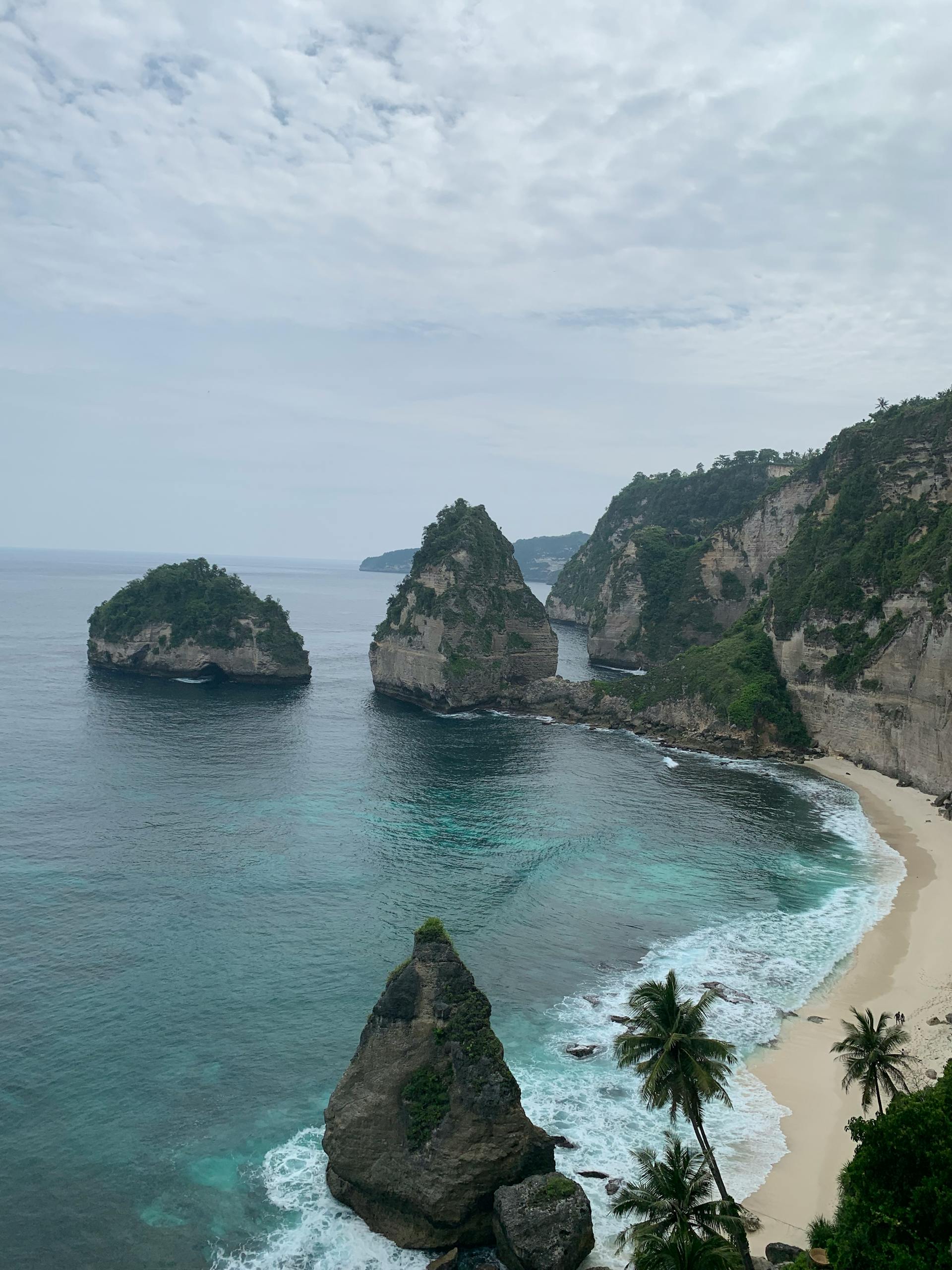
Kelingking is the T-Rex shaped cliff you've seen on every Bali Instagram reel. The viewpoint at the top is genuinely jaw-dropping. The viewpoint is also where the trouble starts.
From the car park, you walk a short rough path to the cliff edge. There are no proper railings at the main photo spot — just a thin bamboo rope in places, and in others, nothing at all. The ground is loose rock and gravel. With a toddler who has just learned to run, this is not a viewpoint, it's a hazard. We will not take a child under 4 to the front rail without being in a carrier on our back. If you go, use a structured carrier (not a sling), keep the baby on the inland side of you, and absolutely do not put a child down to "have a quick look."
The descent to the actual beach is 700+ uneven steps cut into the cliff. Some sections are little more than chiselled handholds in the rock with a bamboo rail bolted on. People have died on this descent. The climb back up takes 45–90 minutes in full sun, and there is no shade, no water for sale, no toilet, no shelter. Do not attempt this with a baby or toddler in a carrier. We don't care how fit you are. The heat alone is a serious risk for an infant, and a slip with a baby strapped to you doesn't bear thinking about. View it from the top, take your photo, and leave.
Realistic plan for Kelingking with under-5s: arrive by 8:30am before the crowds and the heat. Stay 30 minutes maximum. Use the inland warungs for shade and a cold drink. Then move on — or, better, head back to your accommodation for a nap.
The other "famous" beaches: also a no
Diamond Beach and Atuh Beach are on the east coast and look extraordinary from above. Both require long, steep descents — Diamond Beach is a similar story to Kelingking, with steep cut-stone stairs and no proper railings; Atuh has a long winding path down a cliffside. Neither is sensible with a baby in a carrier, and neither is doable with a toddler on foot. If you absolutely need an east-coast moment, the Atuh viewpoint area has a flatter walking section near the top that's tolerable for 10–15 minutes with a stroller (assuming dry weather — these paths turn to slick clay in rain).
Suwehan, Tembeling, Peguyangan (the blue stairs down to the sea temple) — all are spectacular adventure destinations and all are categorically off-limits with a baby. Peguyangan in particular is a near-vertical ladder of stairs bolted to the cliff with a chain handrail. We mention it only because someone will ask. Don't.
It feels brutal to write off this much of the island, but Nusa Penida's geography is what it is. The drama is the cliffs. The cliffs are the problem.
What actually works: the family-accessible spots
Here's where we send families with babies and toddlers. None of these are "easy" by Sanur or Seminyak standards, but they're the realistic options on Nusa Penida.
Crystal Bay. The most baby-friendly beach on the island. There's a flat-ish car park area, a short walk on packed sand to the beach, and patches of natural shade from trees right at the back of the sand. The water is calmer than the cliff-side beaches because it sits in a sheltered bay, though there can still be undertow — don't put a toddler in deep water. Warungs along the back of the beach sell drinks, coconuts and basic food. There are squat-style toilets and a couple of basic changing options. Plan to spend 2–3 hours here, ideally arriving before 10am to claim shade.
Broken Beach (Pasih Uug) viewpoint. One of the few headline spots that's actually accessible. There's a paved, mostly flat walking loop around the rim of the natural arch. A stroller will technically roll on it, but it's easier in a carrier. The drop-offs are real and there are some unfenced sections, so keep your toddler on a hand at all times. Combine it with the neighbouring Angel's Billabong viewpoint — same car park, similar paved approach. Allow an hour total.
Banah Cliff viewpoint. Quieter, paved approach, easier with a pram. Less iconic than Kelingking, but you can stand on a stable platform with rails and look down a stunning section of coast. Ten minutes is plenty.
That's really the list for under-3s. Three spots. Pick one for a half-day, two if your baby is a champion napper and you've had your coffee.
East loop vs west loop: pick one, not both
Local drivers and tour operators talk about Nusa Penida as two loops: the west loop (Kelingking, Crystal Bay, Broken Beach, Angel's Billabong) and the east loop (Diamond, Atuh, Thousand Islands viewpoint, Peguyangan). Couples and groups sometimes do a full loop in a day. You cannot do a full loop with a baby. The roads are too rough, the distances too long, and the heat too unforgiving.
For a family with a baby or toddler, the west loop is the easier of the two — Crystal Bay and Broken Beach are both on it, the roads (while still rough) are better than the east, and you're closer to the boat terminal when it's time to leave. We recommend: arrive on the 8:00am boat, do Broken Beach and Angel's Billabong by 10:00am, head to Crystal Bay for shade and a swim until 1:00pm, then back to the terminal for a 2:00–3:00pm return boat. That's a full day, and it's plenty.
The east loop is worth it only if you're overnighting on the island and willing to break it into two half-days with a long midday nap window between them. More on overnighting in a moment.
Cars, drivers and the state of the roads
Nusa Penida roads are bad. There's no polite way to say it. Some main sections are paved and fine; others are pothole-pocked, single-lane, and shared with trucks, scooters, dogs, chickens and tour vans driving way too fast. The interior roads connecting the viewpoints can be genuinely rough — washboard surfaces that rattle a baby seat for 30 minutes at a time.
Do not ride scooters with a baby on Nusa Penida. We shouldn't have to say this, but we do, every season. Families do it. Families come back regretting it. The combination of loose gravel, sudden potholes, oncoming tour vans on blind corners, and a baby in a wrap with no helmet that fits is not a calculated risk — it's the highest-risk thing you'll do all trip.
Hire a car with driver for the day. On the island, you'll arrange this either through your hotel, the boat company on arrival, or pre-arranged via your Bali driver. Expect a small van or SUV. Do not expect a real ISOFIX-equipped child seat — they're rare on Penida. If you need a proper seat for the day, the realistic options are: bring your own travel car seat from home (a foldable Cosco-style seat works); hire one in Bali before you cross over (our gear rental service can deliver a car seat to your Sanur hotel or directly to the boat); or use a soft sling-style harness, which is better than nothing but not as safe.
Whichever option, accept that you'll be lifting a baby in and out of a car seat onto rough ground multiple times. A carrier slung over your shoulder for the transitions saves your back.
What to pack: the day-trip kit
This is the bag we'd pack for a Nusa Penida day trip with a baby. It's more than you think.
Sun and shade. A pop-up shade tent is the single most useful thing you can bring. Crystal Bay has tree shade if you're lucky and early; almost everywhere else on the island, shade is rare. A UPF rashie for the baby, a wide-brim hat with a chin strap, and reef-safe mineral sunscreen for any exposed skin. SPF 50+ minimum. Reapply every 90 minutes — the equatorial sun on Penida is no joke.
Water and electrolytes. Bring 3 litres of bottled water minimum for two adults and a baby. There are warungs at most viewpoints, but not always between them, and "I'll buy it there" fails the moment you're on a 40-minute road transfer with a thirsty toddler. Add a sachet or two of children's electrolyte powder for the heat.
Food. Warung food on Penida is fine for adults — nasi goreng, mie goreng, fresh coconut — but the options that suit a fussy 18-month-old are limited. Bring familiar snacks: rice crackers, banana, squeeze pouches, a thermos of water for formula. Don't rely on finding baby food anywhere on the island.
Boat and motion sickness. Sea-Band wristbands are licensed for ages 3 and up, so they're not useful for a baby, but they're excellent for a queasy 4-year-old sibling. For babies, the best prevention is feeding right before the boat, holding them in arms (not in a carrier or pram), and sitting low and central on the boat. Bring at least two changes of clothes for the baby — one for sea spray, one for vomit, because you will need them.
Nappies and changing. Pack double what you think you'll use. There are no changing tables at viewpoints. The realistic options are: a changing mat in the boot of the car, on a beach towel under a shade tree, or on your lap at a warung table. A nappy sack for waste and a couple of large zip-lock bags for wet swimmers are essentials.
First aid. Children's paracetamol, oral rehydration sachets, antiseptic wipes, plasters, antihistamine for stings, and a thermometer. The island has small clinics but nothing like the international hospitals back in Kuta or Denpasar (BIMC, Siloam) — you don't want to need one.
Toilets, changing facilities and the dignity question
Let's be honest: facilities on Nusa Penida are basic. Most viewpoints have a single squat toilet behind a warung, with a small fee, sometimes no running water, and definitely no baby change. Crystal Bay has the best of a limited bunch. Broken Beach has functional but rough toilets at the car park.
Practical workarounds: change the baby in the back of the car (a small folding changing mat lives permanently in our day bag); for older toddlers who've potty-trained, bring a portable travel potty and a roll of nappy bags; accept that you'll be hand-sanitising a lot. A bottle of soap and a small towel in the day bag changes the experience.
For breastfeeding mums, warungs are generally relaxed and shaded. A muslin makes it easier in mixed company. Pumping on the boat is not realistic — wait until you're back at the hotel or on land.
Should you overnight on Nusa Penida?
For families with babies, our default recommendation is: day trip from Sanur, don't overnight. The day-trip plan gives you the highlights, keeps you near the better hospitals on the main island, and avoids dragging luggage and a pram across that boarding beach twice in two days.
There are exceptions. If your kids are 4+ and you want to see both loops, or if you specifically want a sunrise at Diamond Beach (still don't take a baby down — but the viewpoint at dawn is gorgeous), an overnight on the west coast near Crystal Bay works. Look for guesthouses with a pool, a generator (power cuts happen), and air-con in the room. Avoid two-storey accommodation if your toddler is climbing.
Nights on Penida are quiet — there's almost no nightlife, which actually suits families fine. Eat early at a warung, watch the sunset, go to bed. The stars are extraordinary because the island is so dark.
Nusa Lembongan as a softer alternative
We've mentioned Lembongan twice already because it's the answer for so many families. The crossing is the same length, the boats leave from the same Sanur beach, and the island is dramatically more baby-friendly. Mushroom Bay and Dream Beach are real beaches you can lie on with a baby. There's a flat coastal path, beach clubs that welcome prams, snorkelling boats that take families, and you can rent a small buggy or bicycle with a kid seat instead of a car.
The headline cliffs of Nusa Penida are visible across the strait. You can do a half-day boat tour from Lembongan that swings past Kelingking and Broken Beach from the water — and honestly, the view from the sea is better than the view from the cliff edge for a family who can't descend.
If you're booking now and you have a child under 3, please at least look at Lembongan first.
A sample day-trip schedule
Here's how we run a Nusa Penida day with a baby for clients who insist on doing it from Sanur. Adjust to your child's nap schedule.
5:45am wake-up, feed and dress the baby, breakfast snacks. 6:15am driver pickup from Sanur hotel. 6:40am arrive at boat operator, board the 7:30am fast boat. 8:15am arrive Nusa Penida, meet pre-arranged island driver, drive to Broken Beach. 9:15am Broken Beach and Angel's Billabong loop, photos, shade break. 10:30am drive to Crystal Bay (about 45 minutes on rough roads — this is the rattly bit). 11:30am Crystal Bay: shade tent set up, lunch at a warung, swim if the baby is up for it, long nap on the beach. 2:00pm pack up, drive to the boat terminal. 3:00pm fast boat return to Sanur. 4:00pm Sanur, driver back to hotel. 5:00pm hotel, bath, dinner, bed by 7.
That's about 11 hours door-to-door. It's a big day. Your baby will be exhausted, you'll be exhausted, and the parent who wasn't prepared will be in tears at the 1pm mark when the heat peaks. Plan a quiet day after.
FAQs
Is Nusa Penida safe for babies? The boat crossing and the accessible viewpoints are reasonably safe with normal precautions. The famous cliff beaches (Kelingking, Diamond, Atuh, Peguyangan) are not safe with a baby and we don't recommend descending them with anyone under 5. View the cliffs from above, stay back from unfenced edges, and stick to Crystal Bay and the paved viewpoints.
What's the minimum age you'd take a child to Nusa Penida? We'd comfortably take a 2-year-old for a half-day at Crystal Bay and Broken Beach. Under 18 months, we'd steer you to Nusa Lembongan instead — same boat, calmer island, dramatically more baby-friendly.
Can you take a pram on the fast boat? Yes, but it goes in the luggage area and gets bashed around. A compact travel pram (umbrella stroller or similar) is far better than a full-size pram. A carrier is still the better choice for the actual boarding moment when staff are wading through surf with bags.
Are there infant life jackets on the fast boats? Not reliably. Adult jackets are standard; infant and toddler jackets are operator-by-operator and often unavailable. Bring your own packable infant PFD from home or hire one in Sanur. This is non-negotiable for us.
Is Kelingking Beach worth visiting if we can't go down? Yes — for 30 minutes, from the upper viewpoint, with the baby in a carrier and well back from the edge. It's an incredible view. Just don't try to descend.
How rough are the roads on Nusa Penida? Worse than the worst roads on mainland Bali. Expect 30–45 minute drives between sites on bumpy, partially-paved roads, with frequent rough sections. Allow more time than Google Maps suggests, and pack motion-sickness gear for older kids.
Should we overnight on Nusa Penida with a baby? Usually no. A day trip from Sanur is plenty, and you'll be closer to better medical facilities on mainland Bali if anything goes wrong. Overnight only makes sense for older children, calmer itineraries, or specifically chasing sunrise on the east loop.
What's the best month to go with a young child? The dry season (roughly May to October) gives you the smoothest boat crossings and the most reliable conditions. November to March is the wet season — boats are sometimes cancelled, cliff paths get slippery, and the heat plus humidity is brutal for babies. We'd aid for the May–September window if you can.
Can we visit Nusa Penida and Nusa Lembongan in one trip? Yes, and for some families it's ideal — base on Lembongan for 2–3 nights with the baby, take a one-day excursion across to Penida's west loop, and you get both islands without the punishing logistics.
What if the baby gets sick on the island? There are small clinics on Penida for minor issues, but anything serious means a fast-boat evacuation back to Sanur and onward to BIMC or Siloam on the mainland. Make sure your travel insurance covers inter-island evacuation. Always bring children's paracetamol, oral rehydration sachets and a thermometer in your day bag.
Nusa Penida is one of the most beautiful places we take families in Bali, but it's the place we have the most honest conversation about — because the gap between the Instagram version and the reality with a baby is bigger here than anywhere else. Done right, it's one big spectacular day. Done wrong, it's the day that breaks your trip. Pre-book your Sanur pickup, your fast boat, your island car, your gear and your return airport transfer at balifamilytravels.com — and let us take the logistics off your plate so you can keep your eyes on the actual baby.
Book a family island day trip: For the easiest Nusa day with kids 4+, see our Nusa Lembongan family day trip (30-minute boat, calm bays). For older kids who tolerate Penida's roads, compare Nusa Penida East and three-island snorkel. Browse all 38 family itineraries.