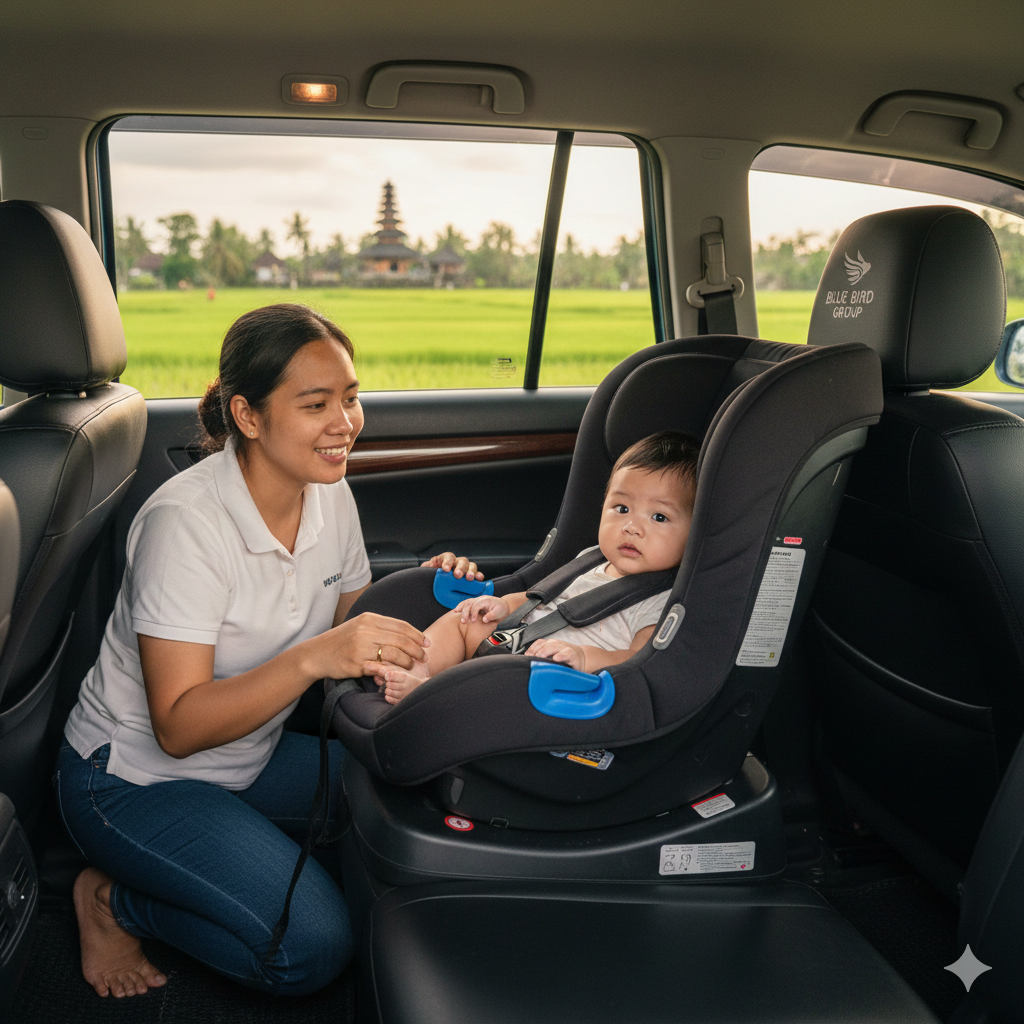
Rear-Facing Baby Capsules in Bali: Why Infants Need Specialised Airport Transfers
Standard Bali transfers often provide the wrong seat for babies under 15 months. Here's why a rear-facing capsule is non-negotiable, and how we set it up correctly for every infant.
Last reviewed:
When travelling to Bali with a newborn or small infant, "safety-ish" isn't an option. While many Bali transport services claim to have "baby seats," what they often provide is a forward-facing toddler seat — designed for older children who can support their own head and neck. For a baby under 12–15 months, that kind of seat isn't just inadequate. It's dangerous.
In 2026, informed parents are specifically searching for a rear-facing baby capsule for their Bali transfer — and for good reason. The difference between the right seat and the wrong one isn't a matter of comfort. It's a matter of spinal protection, airway safety, and crash physics that apply on every road between Ngurah Rai Airport and wherever your holiday begins.
The science of rear-facing safety
An infant's anatomy is fundamentally different from a toddler's or an adult's. Their head accounts for roughly 25% of their total body weight (compared to about 6% for an adult). Their neck vertebrae are not yet fully ossified — the bones are softer, the ligaments more elastic, and the muscles far weaker. This combination means an infant's neck cannot withstand the forces generated in a frontal collision or sudden braking event the way an older child's can.
In a forward-facing seat, a sudden stop causes the child's heavy head to be thrown forward while the harness restrains the torso. The result is extreme tensile force on the cervical spine — the neck stretches while the body stays put. For an infant, this can cause spinal cord injury, internal decapitation (atlanto-occipital dislocation), or fatal cervical fracture. These are not theoretical risks. They are documented in crash investigation literature and are the reason every major child safety authority in the world recommends rear-facing travel for young children.
A rear-facing capsule reverses the physics entirely. When the vehicle decelerates suddenly, the baby is pushed back into the seat shell. The crash force is distributed across the entire surface area of the child's back, shoulders, and head — the strongest, most supported parts of their body. Instead of the neck absorbing the load, the seat absorbs it. The difference in neck force between forward-facing and rear-facing in a 50 km/h frontal impact has been measured at up to 73% reduction (see WHO child restraint effectiveness data).
What the guidelines actually say
Every major safety authority has clear guidance on rear-facing travel:
European i-Size regulation (ECE R129): Requires all children to remain rear-facing until at least 15 months of age. Rear-facing up to approximately 105 cm in height (around 4 years) is supported by the regulation.
American Academy of Pediatrics (AAP): Recommends rear-facing for as long as possible, until the child reaches the maximum height or weight limit of their rear-facing seat. The previous "age 2" guideline has been replaced with this weight/height-based approach.
Australian standard (AS/NZS 1754): Requires rear-facing until at least 6 months, and strongly recommends it until at least 2–3 years. Australia has some of the most rigorous crash-test requirements globally.
World Health Organization: Identifies correctly fitted child restraints as the single most effective intervention for reducing child road fatalities, with rear-facing seats providing the highest level of protection for infants.
The consensus is unambiguous: if your baby is under 15 months, they should be in a rear-facing capsule. If they're under the seat's rear-facing weight or height limit, rear-facing remains the safest option regardless of age.
Why Bali's roads make this even more critical
Rear-facing matters everywhere. On Bali's roads, it matters more:
Stop-and-go traffic: The drive from Ngurah Rai to Seminyak, Canggu, or Ubud involves constant braking — traffic lights, roundabouts, scooter swarms, and pedestrians crossing without warning. Every sudden stop applies deceleration force to your child's neck. In a forward-facing seat, each stop is a micro-event of cervical loading. In a rear-facing capsule, the force is absorbed by the seat shell every time.
Narrow roads and side-on risk: Many Bali roads — particularly between Canggu and Ubud, and throughout the Bukit Peninsula — are narrow, with oncoming traffic passing within centimetres. Side-impact collisions happen in these conditions. A rear-facing capsule with deep side-impact protection wings shields your baby's head and torso from lateral intrusion in a way that a basic forward-facing seat simply cannot.
Long journey times: Airport transfers in Bali are not quick dashes. Ubud is 60–90 minutes. Canggu is 45–75 minutes. Uluwatu is 30–50 minutes. Your baby will be in the seat for a sustained period, making correct recline angle and airway positioning critical — not just crash protection, but ongoing respiratory safety throughout the drive.
Road surface quality: Potholes, speed bumps, and unpaved stretches are common. Vibration and jolting are constant. A rear-facing capsule that is rigidly mounted (ideally ISOFIX) maintains its position and angle throughout, while a poorly secured forward-facing seat can shift, changing the harness geometry and reducing protection.
What we mean by "baby capsule" — and why the name matters
A baby capsule is not the same thing as a baby seat. The distinction matters:
A baby capsule (also called an infant carrier or Group 0+ seat) is a rear-facing shell designed specifically for newborns and young babies, typically from birth to approximately 12–13 kg (around 12 months, depending on the child). It features a deeply reclined angle, a cocoon-like shell with integrated headrest, and a multi-point harness (typically 5-point) that secures the baby within the shell. The capsule attaches to a base station in the vehicle — either via ISOFIX anchors or a seatbelt — and can usually be detached from the base without disturbing the child.
A baby seat is a broader term that can mean almost anything: a forward-facing harness seat, a convertible seat, a booster, or even a backless cushion. When a Bali transport provider says "we have a baby seat," they may be offering any of these — and most are inappropriate for an infant under 12 months.
When you search for a rear-facing baby capsule Bali transfer, you're asking for the specific piece of equipment your baby actually needs. Don't accept a generic "baby seat" as a substitute.
The capsule advantage: car-to-villa without waking your baby
Beyond crash safety, capsules offer a practical benefit that exhausted parents will love. Our infant capsules are designed to detach from the ISOFIX base station or seatbelt base without unbuckling or disturbing the baby. The carry handle locks into position, and you can lift the entire capsule — baby still sleeping — out of the car and carry it directly into your villa, hotel lobby, or restaurant.
After a long flight and a 60-minute transfer to Ubud, the last thing you want is to wake a sleeping newborn during the car-to-cot transition. With a detachable capsule, you don't have to. Set the capsule down on a flat surface inside, let your baby finish their nap, and start unpacking in peace.
This also works in reverse: buckle your baby into the capsule inside your accommodation, carry them to the car, and click the capsule onto the base. No roadside installation, no fumbling with harness straps in the heat. The baby is secured before they even reach the vehicle.
Deep side-impact protection: why it matters in Bali
Not all capsules are built equally. Side-impact protection is one of the features that separates a certified, premium capsule from a generic one. In a side-on collision — the type most likely on Bali's narrow roads — the door intrudes into the passenger compartment. A capsule with deep side-impact protection wings extends a reinforced shell around the baby's head and torso, absorbing and redirecting crash energy before it reaches the child.
Our capsules feature integrated side-impact protection that meets ECE R129 side-impact testing requirements — a test that older ECE R44 seats were not required to pass. The wings are lined with energy-absorbing EPS (expanded polystyrene) foam and the headrest includes additional impact-absorbing material. This matters because side impacts account for a disproportionate share of serious child injuries in vehicle collisions.
Breathable fabrics for Bali's climate
Bali's humidity regularly exceeds 80%, and temperatures hover around 30°C year-round. A baby strapped into a padded capsule can overheat quickly, especially during a long transfer. Overheating is not just uncomfortable — it's a risk factor for heat rash, dehydration, and in extreme cases, heat-related illness in newborns.
Our capsules feature moisture-wicking, breathable fabric covers designed for tropical use. The padding allows airflow between the baby's back and the seat shell, reducing heat buildup. The fabric is also machine-washable and quick-drying, which matters for a fleet that operates in equatorial conditions daily.
Practical tip: dress your baby in a single light cotton layer for the transfer. Avoid bundling them in blankets inside the capsule — loose fabric between the baby and the harness reduces harness effectiveness. If the car is air-conditioned (all of ours are), a muslin over the capsule handle provides shade without trapping heat.
Positional asphyxia: the silent risk most parents don't know about
This is the safety concern that receives the least attention and poses one of the most serious risks to newborns in car seats: positional asphyxia. It occurs when a baby's head falls forward — chin to chest — partially or fully obstructing the airway. In a seat that is too upright, or in a seat not designed for a newborn's size, the baby's underdeveloped neck muscles cannot prevent the head from slumping forward.
Positional asphyxia can occur even without a collision. A baby left in an incorrectly reclined seat during a long drive can silently lose airway patency. The risk is highest for newborns under 4 weeks, premature babies, and infants with low muscle tone.
Prevention comes down to recline angle. Infant capsules are designed with a specific recline range — typically between 30° and 45° from horizontal. At the correct angle, the baby's airway remains open even if their neck muscles relax during sleep. Too upright, and the chin drops. Too flat, and crash protection is compromised.
Our drivers are trained to set the capsule recline angle based on the baby's age and weight before you arrive at the airport. For newborns (0–4 weeks), the capsule is set at maximum recline with the newborn insert in place. For older infants (2–12 months), recline is adjusted based on the child's head control and weight. This is checked during our pre-trip installation protocol — it's not an afterthought.
Our newborn transfer protocol
When you book an infant capsule transfer with us, your baby doesn't just get a seat. They get a service designed around their specific needs:
Pre-arrival setup: Your driver installs the capsule and base in the vehicle before driving to the airport. ISOFIX connection (or seatbelt fitting), recline angle, and harness height are set based on the baby details you provided at booking.
Airport meet-and-greet: Your driver meets you inside the arrivals hall with a name sign. No walking to a distant pickup zone with a newborn. They help with luggage and guide you directly to the vehicle.
Harness fitting: Before departure, the driver adjusts the harness to your baby's actual size — shoulder straps at or just below shoulder level, chest clip at armpit height, harness snug enough that you cannot pinch excess strap material at the shoulder. This 30-second check is the final layer of protection.
Climate control: The car is pre-cooled before your arrival. Air conditioning is running so your baby enters a comfortable vehicle — not a heat-soaked car that's been sitting in the airport parking area.
Capsule detach option: At your destination, if your baby is asleep, the driver can detach the capsule from the base so you can carry your baby inside without unbuckling them. You return the capsule to the driver, or if you've booked a return transfer, we can leave the base installed for your departure day.
What age and weight range do our capsules cover?
Our rear-facing infant capsules accommodate babies from birth to approximately 13 kg (roughly 12–15 months for most children). The key specifications:
Weight range: Birth to 13 kg.
Height range: Up to approximately 75 cm (some models to 83 cm with the headrest fully extended).
Harness: 5-point harness with multiple height positions to grow with your baby.
Newborn insert: Included for babies under approximately 4.5 kg, providing additional head and body support.
Installation: ISOFIX base (default) or seatbelt base, depending on vehicle.
If your child has outgrown the capsule range (over 13 kg or taller than the capsule's shell), we'll recommend a rear-facing toddler seat instead — which extends rear-facing protection up to approximately 18 kg. We carry both, and the correct seat is assigned based on your child's actual measurements, not a generic age bracket.
FAQs
My baby is 14 months — do they still need a rear-facing capsule? At 14 months, most babies have outgrown infant capsules by weight or height. We'd likely assign a rear-facing toddler seat instead, which provides the same directional protection in a larger shell. Share your child's weight and height at booking and we'll match the right seat.
Can I use the capsule for the entire holiday, not just the airport transfer? Our capsules are provided as part of the transfer service and stay with the vehicle. If you need a car seat for your full stay (e.g., for rental car use), contact us at booking — we can discuss extended hire options.
Is it safe for a premature baby to travel in a capsule? Premature and low-birth-weight babies have higher positional asphyxia risk. Consult your paediatrician before flying. If cleared for travel, inform us of your baby's corrected age and weight so we can set the capsule at maximum recline with the newborn insert. For very premature infants, some paediatricians recommend a "car seat challenge" test before the first journey.
What if I'm also travelling with an older child? No problem. Add the second child's details at booking. We'll assign a vehicle with both a rear-facing capsule for your infant and a forward-facing toddler seat or booster for the older child — plus enough luggage space for the full family.
How clean are the capsules? Every capsule is sanitised after each use: fabric cover cleaned, harness straps wiped with baby-safe disinfectant, buckles and base checked for function, and shell inspected for damage. We don't hand you a seat that was last used three bookings ago without being cleaned.
Your baby deserves the right seat — not just any seat
A forward-facing toddler seat for a 3-month-old. A backless booster for a 9-month-old. A dusty, expired capsule from a rental agency. These are the "solutions" that parents encounter when they try to arrange child transport in Bali at the last minute. None of them are acceptable.
When you book a rear-facing baby capsule transfer with us, you get the specific equipment your infant needs: a certified, clean, correctly installed capsule with the recline angle set for your baby's age, the harness adjusted to their size, and a driver who understands why every detail matters. From Ngurah Rai to your hotel, your baby travels the way they should — rear-facing, properly restrained, and safe.