ISOFIX Car Seat Rental in Bali: Why International Safety Standards Matter
Looking for an ISOFIX car seat rental at Bali airport? Here's why rigid anchor installation beats seatbelt-only fitting, what brands we carry, and how we install them correctly.
Last reviewed:
For many parents, "a car seat" isn't enough. You want the same ISOFIX-anchored, crash-tested restraint you trust back home — not a dusty booster pulled from the boot of a random taxi. If you're searching for ISOFIX car seat rental in Bali, you're already asking the right question. In 2026, safety-conscious families are moving away from generic "one-size-fits-all" boosters and demanding rigid, verified anchors.
This guide covers what ISOFIX actually is, why it matters on Bali's roads specifically, what inventory we carry, and how our trained drivers install every seat before you arrive.
What is ISOFIX and why does it matter?
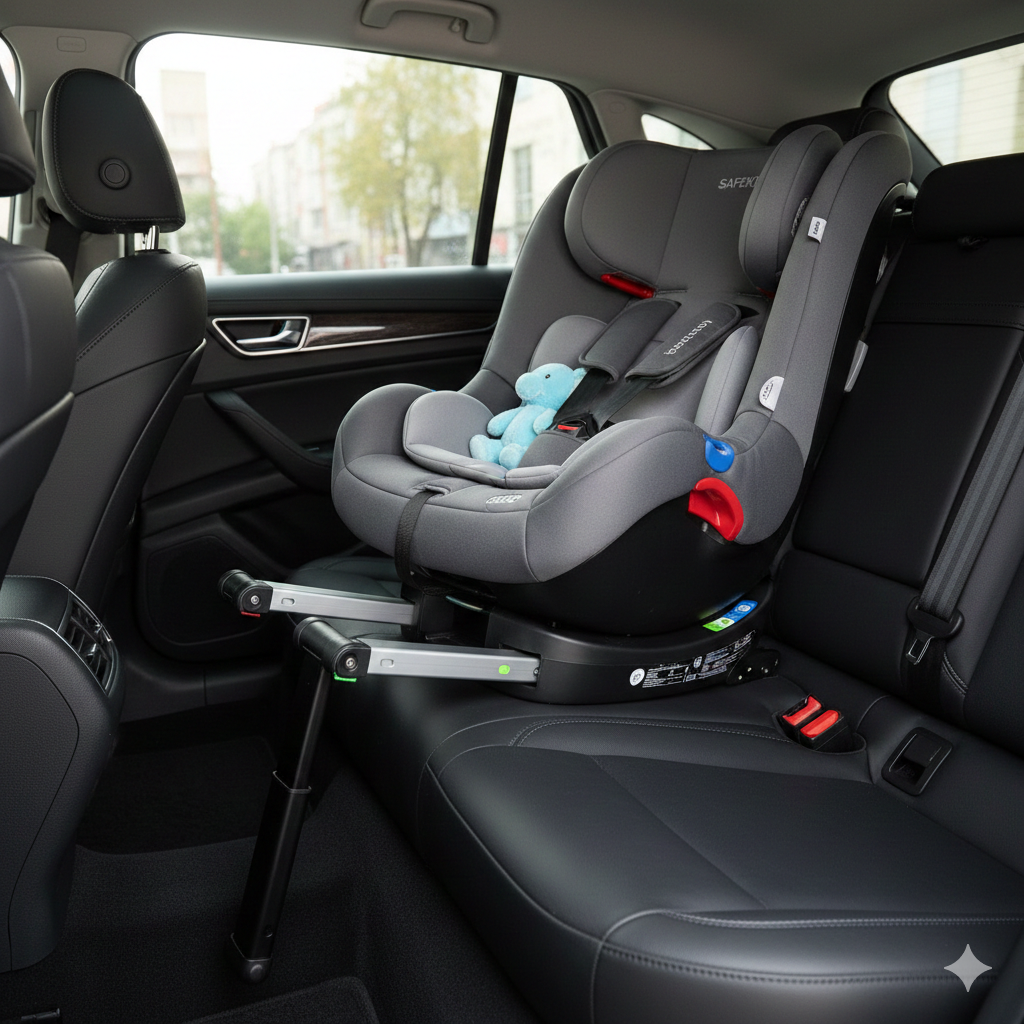
ISOFIX — International Standards Organisation FIX — is a standardised anchoring system that creates a rigid, metal-to-metal connection between a child car seat and the vehicle's chassis. Two steel anchor points are built into the gap between the seat base and backrest of the rear seats. A compatible child seat clicks directly into them with matching connectors. Many seats also include a top tether strap or anti-rotation support leg for additional stability.
The critical advantage is that ISOFIX removes the human variable from installation. With seatbelt-only fitting, the seat is only as safe as the person who routed the belt, pulled it tight, and engaged the locking mechanism. Studies published in Injury Prevention found that nearly 60% of seatbelt-installed child seats had at least one significant fitting error — wrong belt path, insufficient tension, or missed locking clip. For ISOFIX seats, that misuse rate drops below 20%.
For context on installation errors, see Safe Kids Worldwide — car seat installation risks.
The system is binary: the connectors click in and the indicators turn green, or they don't. There's no ambiguity, no "close enough," and no hidden slack. For a holiday transfer on unfamiliar roads, that certainty is worth everything.
Why ISOFIX matters specifically on Bali's roads
Bali's traffic is not like driving in Europe, Australia, or North America. The road environment creates specific demands on child restraint systems that make rigid installation even more important:
Sudden braking: Bali's roads are shared with thousands of scooters, pedestrians, dogs, and ceremonial processions. Drivers brake frequently and without warning. A seat with even slight lateral play — common in poorly tensioned seatbelt installations — shifts forward during deceleration, reducing the distance between your child's head and the seat in front.
Uneven road surfaces: Many roads between the airport and popular destinations (Canggu, Ubud, Uluwatu) have potholes, speed bumps, and unpaved sections. Vibration and jolting can loosen seatbelt tension over the duration of a 45–90 minute drive. ISOFIX connections don't loosen — the rigid anchor holds regardless of road surface.
Narrow lanes and close-proximity driving: Bali traffic flows in tight formation. Side impacts and low-speed collisions happen in congestion. A properly anchored seat distributes crash forces through the vehicle's structure rather than relying on a fabric belt under tension. In a side-impact scenario, the difference between a locked ISOFIX mount and a belt-only fit can be the difference between the seat staying in position and the seat shifting across the back bench.
Long transfer times: Drives from Ngurah Rai Airport to Ubud (60–90 minutes) or Canggu (45–75 minutes) are long enough for a seatbelt installation to gradually lose tension — especially if the belt was routed imperfectly to begin with. ISOFIX maintains the same rigid hold at minute 75 as it did at minute one.
The problem with "standard" car seat rentals in Bali
Several car rental agencies and hotel concierge services in Bali offer car seats. On paper, this sounds like a solution. In practice, the experience is often disappointing and sometimes unsafe:
Unknown seat history: You don't know whether the seat has been in a prior collision. Car seats that have been through a crash — even a minor one — can have compromised shell integrity that isn't visible. Reputable manufacturers recommend replacing any seat involved in an impact.
Expired seats: Child car seats have a manufacturer-defined lifespan, typically 6–10 years from the date of manufacture. The plastic shell degrades over time, especially in Bali's tropical heat and UV exposure. Rental agencies rarely track expiry dates.
Generic, unmatched equipment: Many agencies carry a single type of booster seat and offer it for all ages. A 9-month-old and a 5-year-old have fundamentally different restraint needs. A booster that positions a seatbelt for an older child does nothing to protect an infant who needs a rear-facing harness system.
No installation support: The seat is handed to you. Installation is your problem. In an unfamiliar rental car, at an unfamiliar airport, after a long flight — this is where critical errors happen. Belt routing, tension, locking clip engagement, recline angle — each step must be correct for the seat to protect your child.
Our 2026 inventory: brands and standards you can trust
We carry premium child restraint systems from brands that are crash-tested and certified to international standards. Every seat in our fleet meets or exceeds the following certifications:
European ECE R129 (i-Size): The latest European standard, which requires extended rear-facing until at least 15 months, includes mandatory side-impact testing, and uses height-based rather than weight-only classification for better fit accuracy.
ECE R44/04: The established European regulation still accepted across most markets, covering Groups 0+ through 3 with dynamic crash-test requirements.
Australian AS/NZS 1754: One of the most stringent child restraint standards globally, with additional testing requirements beyond European regulations, particularly for side-impact and rollover scenarios.
Infant capsules (birth to approximately 12 months / up to 13 kg)
Rear-facing capsules from Britax and Maxi-Cosi with ISOFIX base stations. The capsule clicks onto a pre-installed base — the same mechanism used in European and Australian markets. Rear-facing positioning supports the infant's developing neck and spine, distributing crash forces across the back rather than concentrating them on the neck.
Our infant capsules feature adjustable headrest height, newborn inserts for smaller babies, and a 5-point harness with chest clip. The ISOFIX base includes a colour indicator confirming correct installation and an anti-rotation support leg that braces against the vehicle floor.
Toddler seats (approximately 9 months to 4 years / 9–18 kg)
Forward- or rear-facing toddler seats with ISOFIX connectors and top tether strap. The top tether is a critical third anchor point that connects to a dedicated hook behind the rear seat, preventing the top of the child seat from rotating forward during impact. Without the top tether engaged, an ISOFIX seat can still pivot at the anchor points — significantly reducing its protective capability.
Our toddler seats feature multi-position recline for sleeping during longer transfers, side-impact protection wings, and a 5-point harness with anti-slip shoulder pads. We carry both Britax and Maxi-Cosi models to accommodate different vehicle configurations.
Booster seats (approximately 4 to 12 years / 15–36 kg)
High-back boosters that use the vehicle's three-point seatbelt as the restraint mechanism, with the booster guiding belt geometry across the child's shoulder and hips rather than their neck and abdomen. Our boosters include ISOFIX connectors that anchor the empty seat to the vehicle — preventing it from becoming a projectile in a collision when the child isn't seated, and keeping it correctly positioned at all times.
We exclusively stock high-back boosters (not backless). The high back provides head and neck side-impact protection and correctly routes the shoulder belt, which a backless booster cannot do.
How we install every seat: the 6-step protocol
The best seat in the world is only as safe as its installation. Our drivers follow a standardised 6-step fitting protocol for every booking:
Step 1 — Vehicle anchor inspection: Before any seat is fitted, the driver confirms the rear seat ISOFIX anchor points are present, accessible, and undamaged. Anchor condition is checked visually and physically.
Step 2 — Seat-to-vehicle matching: The assigned seat model is confirmed compatible with the specific vehicle. Not every seat fits every car perfectly — some vehicles have shorter seat cushions or steeper backrest angles that affect recline and belt geometry.
Step 3 — ISOFIX connection: Both connectors are pushed onto the anchor bars until the colour indicators show green (locked). The driver confirms each side individually, then checks the connection is rigid by pulling firmly at the belt path.
Step 4 — Top tether or support leg: For infant capsules, the anti-rotation support leg is extended to the vehicle floor and adjusted to the correct length. For toddler seats, the top tether strap is routed over the rear seat and attached to the vehicle's tether anchor hook, then tensioned until firm. This third anchor point is non-negotiable — skipping it reduces the seat's crash performance significantly.
Step 5 — Movement test: The installed seat is pushed and pulled firmly in all directions at the belt path. Acceptable lateral movement is less than 2.5 cm. If it exceeds this, the installation is redone from step 3.
Step 6 — Harness and recline check: The harness is adjusted to the child's expected size (fine-tuned when the child is seated). Recline angle is set based on the child's age — more reclined for younger babies to protect the airway, more upright for toddlers.
ISOFIX vs. seatbelt installation: when we use each method
ISOFIX is our default whenever the vehicle supports it. However, some vehicles in Bali — particularly older Toyota Avanza and Suzuki Ertiga models — lack ISOFIX anchor points. When this happens, we use seatbelt installation with the same rigorous protocol: correct belt routing, tension testing, locking clip engagement, and the 2.5 cm movement threshold.
If you have a strong preference for ISOFIX, let us know at booking. We'll assign a vehicle with confirmed anchor points and notify you in advance if availability changes. You can request ISOFIX specifically in the booking notes.
What makes this different from renting a seat yourself?
When you rent a car seat from a Bali agency, you get a piece of equipment. When you book a transfer with us, you get a system: a verified seat, matched to your child, installed by a trained driver, in a confirmed vehicle, checked before you arrive. The seat is part of the service — not an afterthought bolted on at the last minute.
Every seat in our inventory is:
Purchased new from authorised distributors with full traceability.
Within manufacturer expiry — shell age is tracked and seats are retired before expiration, factoring in Bali's accelerated UV and heat degradation.
Crash-history verified — any seat involved in an incident, however minor, is immediately retired and replaced.
Sanitised after every use — fabric covers cleaned, harness straps wiped, buckles inspected, and shell checked for cracks or wear.
FAQs
Can I request a specific brand? Yes. Note your preference (Britax, Maxi-Cosi, or no preference) when booking. We'll match availability to your request.
Do all your vehicles have ISOFIX? Most do. We prioritise ISOFIX-equipped vehicles for all family bookings. If you need ISOFIX confirmed, request it at booking and we'll guarantee it.
What if my child is between seat categories? Share their exact weight, height, and age. We'll select the appropriate seat based on manufacturer guidelines — not just age alone. Children on the boundary between categories are always placed in the seat that offers more protection, not less.
Can I inspect the seat before we leave the airport? Absolutely. Your driver will walk you through the installation and invite you to check the anchor indicators, tether tension, and harness fit before departure. We welcome informed parents.
Is rear-facing really necessary for toddlers over 12 months? Current best practice — endorsed by the AAP, WHO, and European i-Size regulation — recommends rear-facing until at least 15 months, and ideally until the child reaches the seat's rear-facing weight or height limit. Rear-facing distributes frontal crash forces across the child's entire back rather than concentrating them on the neck. We carry seats that support extended rear-facing up to approximately 18 kg.
Don't settle for "good enough"
Your child's car seat isn't a commodity — it's a safety system. The brand, the certification, the installation method, and the person who fits it all matter. On Bali's roads, where traffic is unpredictable and drives are long, "good enough" isn't good enough.
Book a transfer with ISOFIX-anchored, internationally certified child seats installed by trained drivers. It's the same standard you'd expect from a premium car rental in London, Sydney, or Singapore — available for your Bali airport pickup and every journey during your stay.