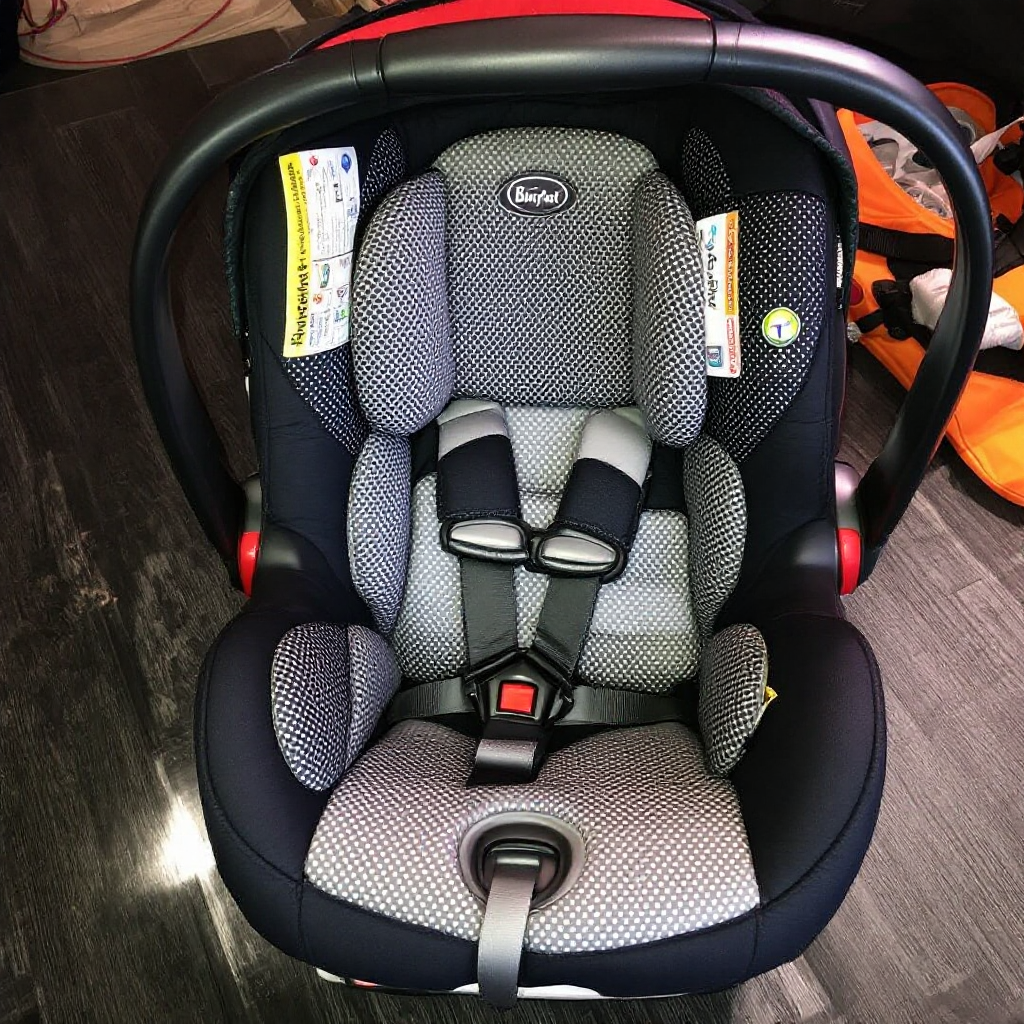
Britax and Maxi-Cosi: Why We Only Use Premium Car Seat Brands in Bali
Many Bali drivers use cheap, uncertified seats from local markets. Here's why we exclusively stock Britax and Maxi-Cosi, how we maintain them in tropical conditions, and what that means for your child's safety.
Last reviewed:
When you're at home, you choose the best for your child. You research crash-test ratings, read reviews, compare harness systems, and spend real money on a seat you trust. Why should that standard drop the moment you land in Indonesia?
The uncomfortable truth is that many "private drivers" and car hire services in Bali buy cheap, unbranded plastic seats from local markets — seats that have never been crash-tested, carry no certification markings, and are made from materials that degrade rapidly in tropical heat. Some are outright counterfeits of recognisable brands. Others are generic shells with basic foam padding and no energy-absorbing structure at all.
That's why Britax car seat hire in Bali has become the benchmark for Australian, European, and safety-conscious families travelling to the island in 2026. If you recognise the brand, you can trust the engineering behind it. Here's what separates premium car seat brands from the rest — and why we refuse to stock anything less.
What makes Britax and Maxi-Cosi different from unbranded seats
The difference between a Britax or Maxi-Cosi car seat and a cheap unbranded alternative isn't cosmetic. It's structural, material, and — ultimately — the difference between a seat that protects your child in a crash and one that doesn't.
Crash-test certification
Every Britax and Maxi-Cosi seat in our fleet has been dynamically crash-tested and certified to at least one of the following international standards:
ECE R129 (i-Size): The current European regulation, which includes mandatory frontal and side-impact testing, requires extended rear-facing until 15 months, and classifies seats by height rather than weight alone for better fit accuracy.
ECE R44/04: The established European standard with frontal-impact dynamic testing at 50 km/h and 30 km/h deceleration tests.
AS/NZS 1754: The Australian and New Zealand standard — one of the toughest in the world — with additional requirements for side-impact protection, rollover performance, and harness strength that exceed European minimums.
An unbranded seat from a Bali market carries none of these certifications. It has not been tested at any impact speed. There is no published data on how it performs in a collision, because nobody has ever tested it. You're trusting your child's life to a piece of plastic that exists because it was cheap to manufacture — not because it was engineered to protect.
Steel-reinforced frames and energy-absorbing structures
Premium car seats are not just plastic shells with padding. Britax seats feature a steel-reinforced substructure within the shell that maintains structural integrity during high-G impact events. When the shell is subjected to crash forces, the steel frame prevents catastrophic deformation — the seat bends and absorbs energy in a controlled manner rather than shattering or collapsing.
Maxi-Cosi seats use a combination of high-density EPS (expanded polystyrene) foam and engineered crumple zones within the shell. In a collision, the EPS foam compresses to absorb kinetic energy before it reaches the child. The crumple zones are designed to deform progressively — managing the energy transfer over milliseconds rather than transmitting the full force instantaneously.
Cheap seats typically use single-layer injection-moulded plastic with thin foam pads. There is no engineered energy absorption. In a collision, the shell either holds rigidly (transferring all crash force directly to the child) or fractures (offering no containment at all). Neither outcome is acceptable.
Adjustable headrests and harness systems
Children grow fast. A seat that fits a 6-month-old may not fit a 14-month-old just eight months later. Britax and Maxi-Cosi seats feature multi-position headrests that adjust vertically to keep the side-impact protection wings aligned with the child's head as they grow. The harness shoulder straps move simultaneously with the headrest — a single adjustment keeps both the head protection and the harness at the correct height.
This matters because a harness that sits too low on the shoulders provides inadequate restraint in a frontal collision (the child can submarine under the straps), while a harness too high fails to engage the child's centre of mass correctly. The "sweet spot" is at or just below shoulder level — and premium seats make it easy to find and maintain.
Unbranded seats typically offer fixed or limited headrest positions, no simultaneous harness adjustment, and generic harness lengths that may be too long or too short for a given child. The result is a seat that's either too loose, too tight, or simply positioned incorrectly — reducing its protective capability before a collision even occurs.
Harness quality and buckle engineering
The 5-point harness is the core restraint mechanism in any child seat. Its job is to distribute crash forces across the strongest parts of the child's body: both shoulders, both hips, and the crotch. Premium harnesses feature:
Anti-twist webbing: Britax and Maxi-Cosi harness straps are engineered to resist twisting. A twisted strap concentrates force on a narrow band of the child's body instead of distributing it — increasing pressure injury risk. Premium webbing lies flat and stays flat.
Precision buckle mechanisms: The central buckle must engage firmly and release smoothly under all conditions, including post-crash when loads may have been extreme. Britax buckles are tested for release force, engagement reliability, and durability over thousands of cycles. A cheap buckle can jam under load, fail to engage properly, or release prematurely.
Chest clip positioning: Premium harness systems include a chest clip designed to sit at armpit height, keeping the shoulder straps in the correct position on the child's shoulders. Without it, straps can slide off small shoulders during impact, dramatically reducing restraint effectiveness.
Why brand familiarity reduces stress and errors
There's a practical argument for premium brands beyond engineering: you already know how to use them. If you have a Britax at home in Sydney, or a Maxi-Cosi in your car in Amsterdam, the harness system, buckle mechanism, and adjustment controls are familiar. You know the click, you know the tension, you know when the harness is right.
Landing after a 6–14 hour flight with a tired, hungry baby and trying to figure out how to buckle them into a strange, foreign-branded seat with unfamiliar straps and an unlabelled buckle mechanism is a recipe for errors. And errors in harness fitting directly reduce crash protection.
By providing Britax and Maxi-Cosi seats in Bali, we create a "home away from home" experience. You recognise the seat. You trust the mechanism. You can verify the harness fit with confidence because you've done it hundreds of times with the same brand. That familiarity is a safety feature in itself — it reduces the chance of incorrect use at the moment when parents are most tired and distracted.
Tropical degradation: why we rotate stock every 2 years
Car seats have a manufacturer-defined lifespan — typically 6 to 10 years from the date of manufacture (NHTSA on car seat expiration). But that lifespan assumes temperate-climate storage and use. Bali's equatorial conditions accelerate material degradation significantly:
UV exposure: Bali receives intense ultraviolet radiation year-round (UV index regularly exceeds 11). UV degrades polycarbonate and polypropylene — the plastics used in car seat shells — causing molecular chain scission (see NHTSA’s guidance on heat, UV, and expiration). Over time, the plastic becomes brittle, losing its ability to flex and absorb energy during impact. A seat that would perform well at 5 years in London may be compromised at 3 years in Bali.
Heat cycling: Vehicles in Bali can reach 60°C+ interior temperatures when parked in direct sun. Repeated heating and cooling cycles stress plastic at the molecular level, accelerating fatigue cracking — particularly around stress concentration points like ISOFIX connector housings and harness slot mouldings.
Humidity: Sustained humidity above 80% promotes corrosion of metal components (harness adjusters, ISOFIX connectors, buckle springs) and can degrade foam padding, reducing its energy-absorbing capacity.
Because of these factors, we retire and replace our seat inventory on a 2-year cycle — well within the manufacturer's rated lifespan but calibrated for the accelerated wear of tropical fleet use. Every seat is date-stamped at purchase, inspected monthly for shell condition, and pulled from service at 24 months regardless of visible condition. We don't wait for a seat to look degraded. We replace it before degradation becomes a factor.
Our current fleet inventory
As of 2026, our fleet includes the following models, covering every age group from newborn to 12 years:
Britax Safe-n-Sound b-first (infant capsule)
Rear-facing from birth to approximately 12 months (up to 13 kg). Australian-certified to AS/NZS 1754. ISOFIX base with support leg. Deep side-impact protection, newborn insert, and 5-point harness with anti-twist straps. The gold standard for Australian families and one of the highest-rated infant capsules globally.
Maxi-Cosi Pebble 360 (infant capsule)
Rear-facing from birth to approximately 15 months (up to 13 kg). Certified to ECE R129 (i-Size) including side-impact testing. 360° rotating base for easy loading and unloading — particularly useful when parked in tight Bali car parks. ISOFIX installation with colour indicators.
Britax Kidfix III S (toddler/booster)
Forward-facing with ISOFIX and top tether from approximately 9 kg to 36 kg (roughly 9 months to 12 years across multiple configurations). V-shaped headrest with deep side-impact protection. SecureGuard — a unique Britax feature that adds a fourth anchor point at lap level, reducing abdominal force by up to 35% in frontal collisions.
Maxi-Cosi Titan Pro i-Size (toddler to junior)
Multi-stage seat covering approximately 9 months to 12 years (76–150 cm). ISOFIX with top tether. ClimaFlow temperature-regulating padding — designed for exactly the conditions Bali presents. G-CELL side-impact technology with a honeycomb-structure energy absorber built into the shell walls.
High-back boosters (Britax and Maxi-Cosi)
For older children (approximately 4–12 years, 100–150 cm) who need seatbelt positioning support. ISOFIX-anchored to prevent the empty seat becoming a projectile. High-back design provides head and neck side-impact protection that backless boosters cannot offer. We do not stock backless boosters — the safety trade-off is not acceptable for our service.
How we match the right seat to your child
Brand alone doesn't guarantee safety — the seat must also be the right size for the child using it. An excellent seat in the wrong size category provides reduced protection. Our matching process works like this:
1. You provide your child's age, weight, and height at booking. All three matter. A tall, light 2-year-old may need a different seat than a heavy, compact 2-year-old of the same age.
2. We assign the seat based on manufacturer guidelines. Each seat has a defined weight and height range. We place your child in the seat that best fits their current measurements — not their age bracket.
3. Borderline cases default to more protection. If your child is between categories, we assign the seat that offers more containment, not less. A toddler on the cusp of booster eligibility stays in the harnessed seat until they clearly exceed its range.
4. Final harness adjustment happens at pickup. The driver confirms shoulder strap height, harness tension, and headrest position with your child in the seat before departure. This 60-second check is the final quality gate.
What about counterfeits?
Counterfeit car seats are a real problem in Southeast Asia. They look like the genuine product — sometimes with convincing logos, stickers, and packaging — but they are manufactured with inferior materials, lack the internal reinforcement structures, and have never been tested to any standard. In a collision, they fail.
We purchase all seats directly from authorised distributors in Australia and Europe, with full batch traceability and proof of authenticity. Every seat in our fleet has a verifiable manufacture date, model number, and certification label that matches the manufacturer's records. If you'd like to verify any seat's authenticity, we're happy to show you the certification label and explain what each marking means.
FAQs
Can I request Britax specifically over Maxi-Cosi (or vice versa)? Yes. Add your brand preference in the booking notes. We'll match it where inventory allows. If your preferred brand isn't available for the specific seat category and date, we'll notify you in advance and offer the alternative.
Are these the same models I'd buy in Australia or Europe? Yes. We stock models that are sold and certified in Australian and European markets. They are not region-specific variants or export models with reduced specifications.
How often do you replace seats? Every 2 years from the date of purchase, or sooner if any seat is involved in a collision (however minor), shows visible shell damage, or fails a monthly inspection. Bali's climate accelerates plastic degradation, so we apply a more aggressive replacement cycle than the manufacturer's rated lifespan.
What happens to retired seats? They are destroyed, not resold. A retired car seat should never re-enter circulation — its protective capacity can no longer be guaranteed. We cut the harness and mark the shell before disposal to prevent reuse.
Do premium seats cost more to book? Premium seats are included in the standard transfer price. We don't charge extra for Britax or Maxi-Cosi — they're the baseline, not an upgrade. Every family booking includes a certified, correctly sized seat from our fleet at no additional cost.
Premium gear for premium holidays
You've invested in flights, a beautiful villa, and a holiday your family will remember. A sub-par car seat is the weakest link in that plan — and the one with the highest consequences if something goes wrong.
Demand the brands you know. Demand the certifications you trust. Demand a provider that rotates stock, trains drivers on installation, and treats your child's car seat as a critical safety system rather than an afterthought. That's what we do — for every booking, every transfer, every family that lands in Bali.