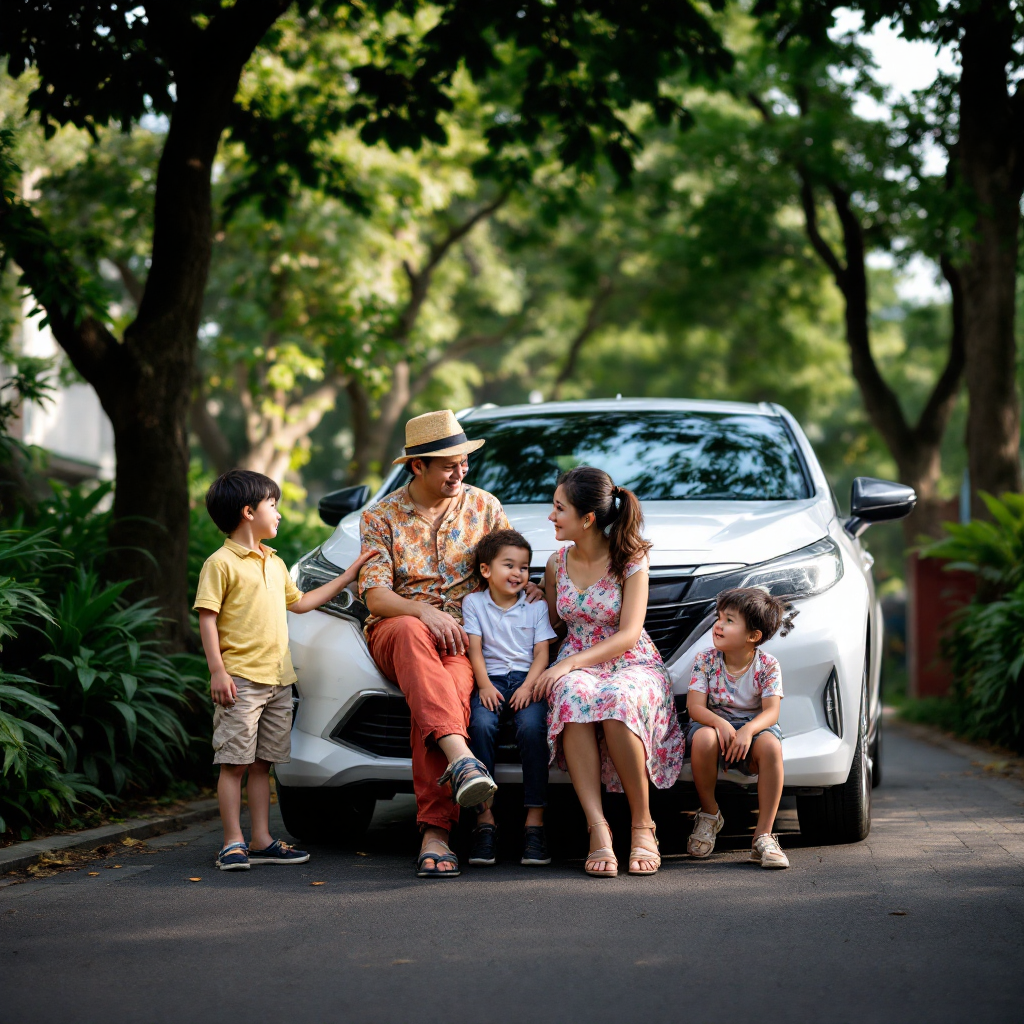
Large Family Logistics: Booking a Bali Airport Transfer with 2+ Car Seats
Most Bali sedans can't fit two car seats and a family's luggage. Here's how to book the right vehicle — Toyota Innova, HiAce, or larger — with multiple child seats correctly installed.
Last reviewed:
Travelling as a family of four or five presents a logistics challenge that most Bali transport providers aren't set up to handle. A standard sedan — the Toyota Avanza that dominates airport taxi ranks and ride-hail fleets — has a cramped back seat, limited boot space, and no ISOFIX anchor points in some model years. Fitting two bulky child car seats side by side, plus an adult next to them, plus four suitcases, a stroller, and two sets of baby gear? It doesn't work.
If you need a Bali airport transfer with 2 car seats — or even three — you need to plan ahead, choose the right vehicle, and work with a provider that understands multi-seat logistics. This guide covers vehicle options, seating configurations, luggage planning, and how to make sure the right car arrives with the right setup.
Why standard sedans don't work for two car seats
The Toyota Avanza is the most common vehicle in Bali's taxi and ride-hail fleets. It's affordable, fuel-efficient, and ubiquitous. It's also a terrible vehicle for families with multiple children in car seats. Here's why:
Rear seat width: The Avanza's rear bench measures approximately 125 cm across. Two child seats — even compact ones — take up around 90–100 cm. That leaves 25–35 cm for an adult to sit between or beside them. In practice, it's a squeeze that makes harness adjustment, mid-journey soothing, and emergency unbuckling extremely difficult.
ISOFIX availability: Older Avanza models (pre-2019) often lack ISOFIX anchor points entirely. Newer models may have two outboard ISOFIX positions, but fitting two ISOFIX seats can still be tight due to shell width and connector clearance. If the car seats physically touch each other, the ISOFIX connectors may not fully engage — a critical installation failure that isn't always visually obvious.
Boot space: With two car seats installed, the rear seats may need to be pushed forward slightly, reducing legroom. The Avanza's boot is already modest at approximately 240 litres. Add a compact stroller, two carry-on bags, and two checked suitcases, and you've exceeded capacity before adding nappy bags, formula supplies, and beach gear.
No third-row option: In an Avanza, the rear bench is it. There's no flexibility to spread seats across rows, separate children who bother each other, or seat an adult comfortably beside both seats for hands-on supervision.
The Toyota Innova: the family workhorse
The Toyota Innova (specifically the Innova Zenix and Innova Crysta models available in Bali in 2026) is the vehicle we recommend for families needing two car seats. It's the most popular MPV in Southeast Asia for a reason — it bridges the gap between sedan and full-size van with a combination of space, ride quality, and reliability that works perfectly for family airport transfers.
Seating and car seat configurations
The Innova has three rows of seating. This flexibility is the key advantage for multi-seat families:
Configuration 1 — Two seats in the second row: Both child seats installed side by side in Row 2, with one parent seated beside them. The second parent sits in the front passenger seat. This keeps both children within arm's reach and allows the supervising parent to adjust harnesses, offer drinks, and soothe without turning around. Best for two children of similar ages who need active supervision (e.g., two toddlers).
Configuration 2 — Split across rows: One child seat in Row 2, one in Row 3. One parent sits beside each child. This works well when children have different needs — for example, a rear-facing infant capsule in Row 2 (requiring a parent to monitor breathing and head position) and a forward-facing toddler seat in Row 3 with an older sibling who needs less supervision. It also gives each child more space and reduces the "touching each other" conflict that long drives can trigger.
Configuration 3 — Two seats plus a booster: For families with three children, two harnessed seats in Row 2 and a high-back booster in Row 3 (or vice versa). The Innova's anchor points and seatbelt positions support this configuration, though luggage space becomes tight. For three seats, we may recommend a Toyota HiAce instead (see below).
Cargo space
The Innova's boot — with the third row folded or with Row 3 used for a child seat — offers approximately 300–450 litres of cargo space depending on configuration. That comfortably handles:
2 large checked suitcases (23 kg class), 1–2 carry-on bags, 1 compact stroller (folded), 1 nappy bag / day pack, and loose items (car seat bag, beach bag, etc.).
If your luggage load exceeds this — large pram, surfboard, or extra cases — let us know at booking and we'll either adjust the configuration or assign a larger vehicle.
Ride quality
The Innova's suspension is tuned for comfort over rough roads — a significant advantage in Bali. The drive from Ngurah Rai to Ubud includes sections of uneven tarmac, speed bumps, and winding hill roads. For children in car seats, a smoother ride means less jostling, less nausea, and a better chance of sleeping through the transfer. The Innova handles this better than both the Avanza (which transmits more road noise and vibration) and many larger vans (which can feel heavy and wallowing on tight corners).
The air conditioning system is zoned, with rear vents that reach both Row 2 and Row 3. For a vehicle carrying two children in padded car seats in tropical heat, effective rear climate control is not a luxury — it prevents overheating and keeps children comfortable during the 45–90 minute airport transfer.
When you need something bigger: the Toyota HiAce
For larger family groups — three children in car seats, families travelling with grandparents, or groups with exceptional luggage loads — the Toyota HiAce van offers the space that even the Innova can't match:
Passenger capacity: Up to 12 seats in the standard configuration, with flexible row layouts that allow three car seats across a single row with space to spare.
ISOFIX positions: Multiple anchor points across rows, giving full flexibility for seat placement and mixed configurations (e.g., two capsules and one booster across different rows).
Cargo area: Dedicated rear cargo area separated from the passenger cabin. Large enough for multiple suitcases, prams, and equipment without encroaching on seating space.
Standing headroom: The HiAce's interior height allows parents to stand while buckling children into seats — a significant practical advantage over crawling into a low-roofed sedan to reach a second-row car seat.
The trade-off is that the HiAce is a larger vehicle that takes slightly longer to navigate Bali's narrower streets (particularly in Canggu and parts of Ubud). For most airport transfers and inter-area journeys, this isn't an issue — the main roads between Ngurah Rai and popular destinations are HiAce-friendly.
How we coordinate multiple seats
Finding one car seat in Bali is manageable. Finding two or three matching, high-quality, correctly sized seats installed in the same clean vehicle is a logistics problem that most providers can't or won't solve. Here's how we handle it:
Step 1 — Child details at booking: You provide each child's age, weight, and height. For two or more children, we need this information for every child — not just "two toddlers." A 10 kg 14-month-old and a 15 kg 3-year-old need different seats, different harness settings, and potentially different facing directions.
Step 2 — Seat assignment: Each child is matched to the correct seat from our fleet: infant capsule, rear-facing toddler seat, forward-facing toddler seat, or high-back booster. The combination determines the vehicle — two capsules require more width than two boosters, for example.
Step 3 — Vehicle assignment: Based on the seat combination, the number of adult passengers, and the estimated luggage load, we assign the appropriate vehicle. Two seats usually means an Innova. Three seats, or two seats with very heavy luggage, may trigger a HiAce.
Step 4 — Pre-installation: Both (or all three) seats are installed in the vehicle before the driver leaves for the airport. Each seat goes through our standard installation protocol: ISOFIX or seatbelt fitting, anchor check, movement test (less than 2.5 cm lateral play), top tether engagement, and recline angle setting. This happens at our base, not in the airport car park.
Step 5 — Configuration confirmation: You receive a WhatsApp message or email confirming the vehicle model, seat types, and seating layout before pickup day. If anything changes (vehicle swap, seat availability), we notify you in advance and confirm the alternative.
The "two taxi" problem — and why it's worse than it sounds
Many families arriving in Bali without pre-booked transport try to "wing it" at the airport. With two children needing car seats, here's what typically happens:
Scenario 1 — No seats at all: You take a standard taxi or Grab. Both children are held on laps. Unsafe for the entire journey.
Scenario 2 — One seat, one lap: You manage to find a driver with a single child seat (rare), but the second child still has no restraint. You've halved the problem but not solved it.
Scenario 3 — Two separate taxis: You split the family across two vehicles so each parent can hold one child. This doubles the cost, separates the family (stressful for children and parents alike), and still leaves both children unrestrained. It also means coordinating two separate routes, two separate ETAs, and managing luggage split across two cars.
Scenario 4 — The airport meltdown: You spend 30–45 minutes at the airport trying to arrange a vehicle that works, in the heat, with two tired children, while taxi touts compete for your attention. Eventually you take whatever's available out of exhaustion. Nobody is buckled in safely. The holiday starts badly.
Every one of these scenarios is avoidable with a single pre-booking. One vehicle, two (or three) seats, the right size car, everyone together, everyone safe.
Luggage planning for multi-child families
Luggage is the hidden constraint that catches families off guard. With two or more children, your luggage load roughly doubles compared to a couple:
Typical luggage for a family of four (two adults, two children under 4): 2 large suitcases, 1–2 carry-on bags, 1 stroller (compact or full-size), 1 nappy bag, 1 formula/feeding bag, potentially 1 travel cot or beach gear bag.
That's 5–7 pieces before personal items. In a standard sedan, this doesn't fit even without car seats. In an Innova with the third row available for cargo, it works. In a HiAce, it's comfortable.
When you book with us, tell us your estimated luggage load — number of checked bags, stroller type (compact/umbrella or full-size), and any oversized items. We factor this into vehicle assignment so there are no surprises at the kerb. If you're travelling with a full-size pram (like a Bugaboo Fox or Uppababy Vista), mention it specifically — these take significantly more boot space than a Yoyo-style travel stroller.
Common multi-seat configurations we handle
Here are the most frequent configurations we set up for families, with the typical vehicle assignment:
1 infant capsule + 1 toddler seat: Innova, both in Row 2. Parent sits beside. Common for families with a newborn and a 2–3 year old.
2 toddler seats (same age): Innova, both in Row 2 or split Row 2/Row 3 depending on parent preference. Common for twins.
1 toddler seat + 1 booster: Innova, Row 2. The booster takes less width, leaving more room for the parent between. Common for families with a 2-year-old and a 5–6 year old.
2 infant capsules (twins): Innova or HiAce depending on luggage. Two capsules in Row 2 is tight but workable in the Innova; a HiAce gives much more breathing room. Luggage is the deciding factor.
3 seats (any combination): HiAce. Three seats across a single row or split across Row 2 and Row 3. Common for families with three children or families travelling with a friend's child.
2 seats + 1 adult wheelchair or mobility equipment: HiAce with accessible loading. Less common but something we accommodate — contact us at booking to discuss specifics.
Drive times and route considerations
With two or more children in the car, the journey itself matters more. Here are typical drive times from Ngurah Rai and what to expect on each route:
Seminyak: 30–45 minutes. Mostly flat, good roads. Traffic can be heavy 4–8 PM. Manageable for most children.
Canggu: 45–75 minutes. Sections of narrow road and construction zones (ongoing in 2026). Some bumpy stretches. Plan for the upper end of the range during peak hours.
Ubud: 60–90 minutes. The longest common transfer. Includes winding hill roads north of Denpasar. Feed and change babies before departure if possible — there are no convenient stops on the Ubud route.
Uluwatu / Bukit Peninsula: 30–50 minutes. Good highway for the first section, then winding peninsula roads. Steep gradients in places. The Innova handles these well; its torque and suspension are better suited to the Bukit hills than a sedan.
Nusa Dua: 20–30 minutes. The easiest transfer — flat toll road for most of the route. Quick and smooth.
For drives over 60 minutes with two young children, we recommend timing your transfer to coincide with a nap window. A post-flight nap in a comfortable car seat, with the AC running, can reset even the most overtired toddler. Let us know your flight arrival time and we'll suggest the optimal departure strategy.
FAQs
Can I fit two car seats in a regular Grab or taxi? Physically, maybe — in a cramped, unsafe configuration with no ISOFIX and no luggage space. Practically, no. Standard taxis and ride-hail vehicles are not set up for multi-seat installations. We strongly recommend against attempting it.
Do I pay extra for the Innova over a sedan? Vehicle pricing is based on the transfer route and vehicle type. An Innova transfer costs more than a sedan, but less than two sedans — which is what you'd need to attempt the same journey safely without a multi-seat vehicle. The price includes all car seats at no additional charge.
What if my children are different ages — can you mix seat types? Absolutely. Mixing is the norm, not the exception. Most families with two children need two different seats. Tell us each child's details and we'll handle the combination.
Can the driver help with luggage? Yes. Our drivers assist with loading and unloading luggage at both the airport and your destination. With two children to manage, extra hands make a real difference.
What if I'm travelling with another family? We can arrange multi-vehicle convoys or a single large vehicle (HiAce) depending on the total number of children, seats, and luggage. Contact us with the full group details and we'll propose the best configuration.
Can I book a return transfer with the same setup? Yes. Book your return at the same time and we'll ensure the same vehicle type and seat configuration. For multi-day bookings (airport pickup + day tours + airport return), we can often assign the same driver and vehicle throughout your stay.
Keep the family together, keep everyone safe
Splitting your family across two taxis, holding children on laps, or cramming seats into a vehicle that can't fit them are all compromises that parents shouldn't have to make. The right vehicle with the right seats, pre-installed and confirmed before you land, solves the entire problem in a single booking.
Tell us how many children, their ages and sizes, your luggage load, and your destination. We'll assign the vehicle, install the seats, and meet you at arrivals. Your family stays together, everyone is buckled in, and the holiday starts the way it should.