Bali Private Driver vs Grab and Gojek: Which Works for Families in 2026?
A parent-to-parent comparison of Grab, Gojek and private drivers in Bali — covering cost, child seats, surge, no-go zones and which to pick with kids in tow.
Last reviewed:
If you're trying to work out whether to thumb a Grab from the airport, tap Gojek between cafes in Seminyak, or pre-book a private driver for the week, this is the comparison we wish we'd had on our first family trip. The short version: ride-hail apps are great for a solo adult bouncing around south Bali, but they fall apart the moment you add kids, luggage, multiple stops, or a drive outside the Kuta-Seminyak-Canggu triangle. Below is the honest breakdown — when Grab and Gojek shine, where they quietly let you down, and when a private driver is the only sensible option.
What Grab and Gojek actually are
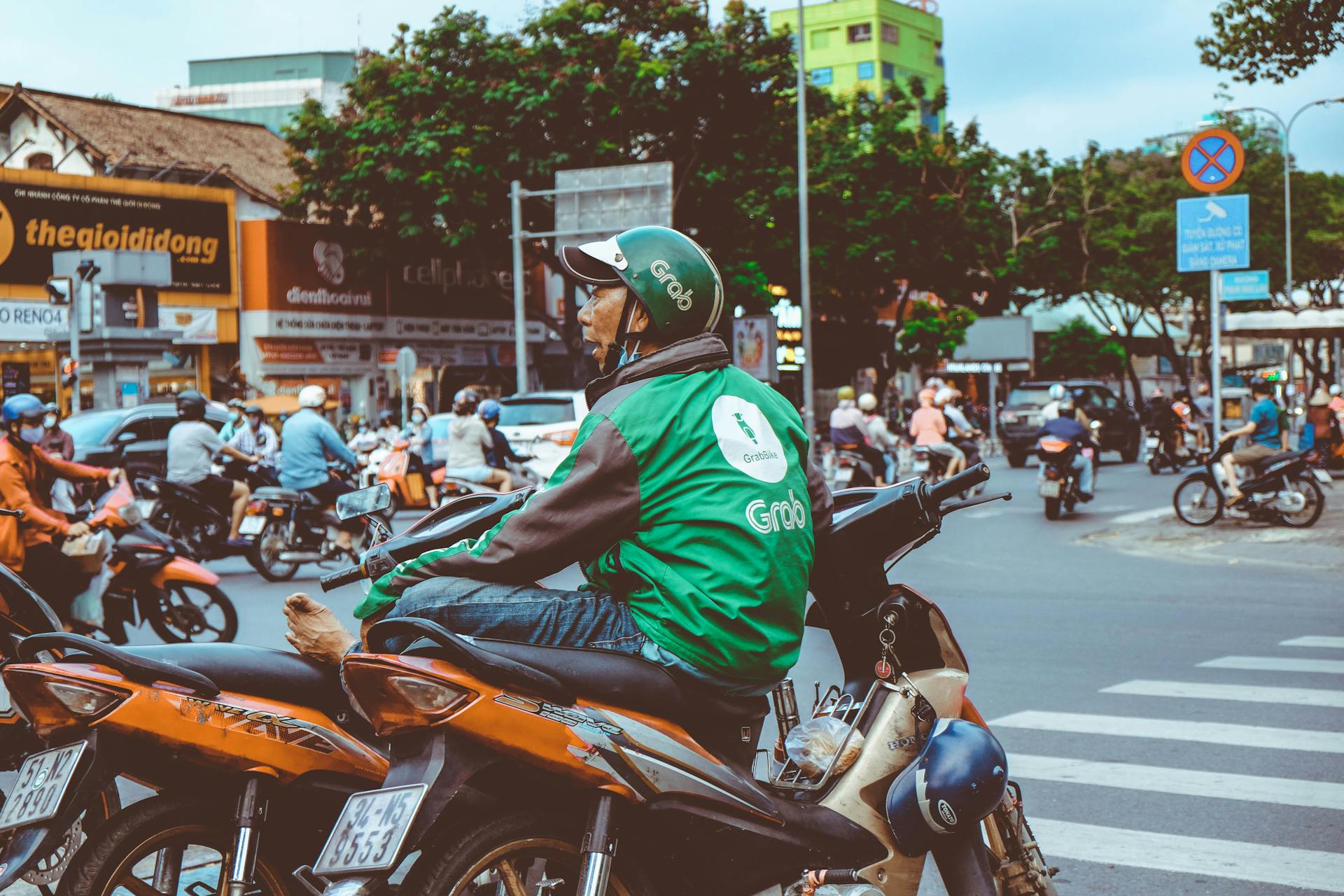
Grab and Gojek are the two big ride-hail apps in Indonesia. Both work like Uber: open the app, drop a pin, accept a price, watch a little car icon weave towards you. Both let you pay with a registered card or with the in-app e-wallet (GrabPay, GoPay), which means no fumbling for cash or arguing about change. Both apps are in English, both have ratings and a panic button, and both also offer motorbike rides (GrabBike, GoRide), food delivery, parcel courier and a handful of other services.
For a backpacker or a solo traveller in south Bali they're genuinely brilliant. You can get from a beach club in Seminyak to a warung in Kerobokan for the price of a coffee back home. The driver shows up in five to fifteen minutes, the fare is locked in before you accept, and you don't need a word of Bahasa Indonesia.
The catch — and it's a big one for families — is that ride-hail in Bali is not the seamless experience it is in Sydney, Melbourne or London. Bali has a complicated relationship with the apps, the cars are not standardised, the coverage is patchy outside the south, and there is no provision whatsoever for child seats. We'll walk through all of that.
Where Grab and Gojek genuinely shine
If you're staying in Seminyak, Kuta, Legian, Jimbaran or central Canggu and you only need to hop a few kilometres at a time, the apps are hard to beat. Short urban rides between dinner and your villa, a quick run to a pharmacy, a beer-too-many trip home — this is exactly what they were built for. The pricing is transparent, the drivers are tracked, and the cars (when they show up) are usually small sedans with working air-con.
The English-language apps remove a whole layer of friction. You don't negotiate, you don't haggle, you don't need to know the Indonesian name of your destination — drop a pin and go. For mums and dads who've spent the day wrangling kids and don't have the energy for a fare conversation in the dark, that matters.
In-app payment is the other genuine win. You can pre-load GrabPay or GoPay with rupiah using your card, and from then on every ride, every nasi goreng delivery, every bottle of water from the convenience store comes out of the same balance. No ATMs, no cash-handling, no working out whether 75,000 rupiah is a fair tip. For a two-week trip with kids, that's a small but real reduction in mental load.
Finally, the apps are cheap. A short hop in Seminyak might run you the equivalent of a couple of Aussie dollars. Even a longer ride within the south — say Kuta to Canggu — is usually well under twenty. If you're travelling without small children and the route is inside the ride-hail-friendly zones, there's no contest on price.
The car seat problem (this is the big one)
Here is the thing nobody at the airport tells you: Grab and Gojek do not provide child seats. Ever. Not as an option, not for extra money, not on request. The driver who picks you up is a private individual who's signed up to drive his own car for the platform. He's not carrying a Maxi-Cosi in the boot just in case.
If you have a baby, a toddler or a primary-school-age child, you have three options inside a Grab or Gojek. You can hold the baby on your lap (illegal at home, dangerous everywhere, and the standard local approach). You can buckle the child into an adult seatbelt that wasn't designed for them. Or you can bring your own car seat and try to install it in the back of a stranger's sedan, in the dark, with the meter running and a queue of scooters honking behind you.
We've done the third one. It's miserable. Half the cars in the ride-hail fleet have ISOFIX anchors that are either missing, hidden under permanently-attached seat covers, or simply not where the manual says they should be. The seatbelt geometry varies car to car. The driver, polite as he is, has no idea what you're doing and is keen to get moving. By the time you've got the seat in, you've burned twenty minutes and the fare you saved versus a private driver is gone.
By contrast, every vehicle assigned to a booking has an ISOFIX child seat appropriate for the age of your kids, already installed and checked before pickup. That's not a marketing line, it's why families book through us. If you want to see what's available, our gear-rental page lists the seats and prams partner providers keep on their vehicles.
Surge pricing, cancellations and the no-show lottery
The other quiet disappointment with ride-hail in Bali is reliability. The locked-in fare is only locked in if a driver actually accepts and shows up. In practice, on a rainy evening in Canggu or after a big event in Uluwatu, you can sit on the kerb for half an hour watching drivers accept, drive two hundred metres towards you, and then cancel because they got a better offer or didn't want the trip.
Surge pricing is real and aggressive. A fare that's 70,000 rupiah at lunchtime can be 200,000 in a downpour. That's still cheap by Australian standards, but it undermines the "cheapest option" argument once you're doing it three or four times a day with a family of four. Add a couple of cancellations and the time cost gets ugly.
We've watched families miss flights because they trusted ride-hail for the run back to Denpasar airport in peak hour. There's no flight tracking in Grab or Gojek. If your driver cancels at 4am, you're back in the app refreshing while the clock runs down. A pre-booked private driver, by contrast, is sitting in your villa driveway at the agreed time, with your flight number on his sheet, and adjusts if the airline pushes the departure.
The "no-go zone" problem nobody warns you about
This one catches a lot of first-time visitors off guard. Parts of Bali — most famously central Ubud, pockets of Canggu and stretches around some traditional markets and temple complexes — have informal restrictions on ride-hail pickups. You'll see signs that say "no online taxi" or, more bluntly, drivers will refuse to come down certain streets.
The reason is political. Local transport co-operatives and traditional taxi groups have, in various villages, negotiated with the banjar (the village council) to restrict the apps from picking up passengers in their patch. Sometimes the rule is enforced by signage and a polite refusal. Sometimes there are spotters. Occasionally there are unpleasant scenes when a Grab driver is caught loading passengers in the wrong spot.
What this means for you, the parent, is that your app might happily accept a fare from your Ubud villa, but the driver will phone and ask you to walk five minutes up the road to a different pickup point — often with luggage, often with a sleeping toddler in your arms. Or the ride will be accepted and then quietly cancelled. Or you'll wait, and wait, and watch the icon hover at the edge of the village without coming in.
Private drivers operate in a different category and aren't subject to the same restrictions. A driver booked through us, or any reputable transfer service, can collect you from your villa door in Ubud or central Canggu without drama. For airport runs and day trips that start in those areas, this alone is worth the price difference.
Coverage outside south Bali
The ride-hail apps work brilliantly in the rectangle from the airport up through Kuta, Seminyak, Canggu and across to Sanur. They work passably in Ubud, with the caveats above. They work badly almost everywhere else.
If your itinerary includes Amed, Lovina, Munduk, Sidemen, Pemuteran, Nusa Penida (you're not getting a Grab on the island in any case), the north coast, or the inland villages around Mount Batur, you're going to spend a lot of time staring at "no drivers available". Even the popular day-trip destinations — Tegallalang rice terraces, Tirta Empul, Tanah Lot — sit in zones where you might get there fine but struggle to get a ride back.
Families building an itinerary beyond the south need to think of ride-hail as a top-up for short urban runs, not as their backbone. The backbone is a driver — either pre-booked for specific transfers, or hired by the day for tours.
Vehicle quality: the lottery
Because Grab and Gojek drivers use their own cars, what shows up varies wildly. We've climbed into immaculate four-year-old SUVs with chilled air-con and bottled water in the cup holders. We've also climbed into fifteen-year-old hatchbacks with broken seatbelt buckles, a cracked dashboard and air-con that wheezed warm air at us across the south of the island.
For a quick ride in good weather it doesn't matter. For an hour-long transfer in midday heat with two sweaty kids, it matters a lot. The cars on the ride-hail platforms are not inspected or graded by the apps in any meaningful way — your protection is the star rating, and most drivers hover above 4.7 because passengers don't routinely punish a tired air-con unit.
A reputable private-driver service runs a controlled fleet. The cars are serviced on a schedule, the air-con is checked, the seats and floors are cleaned between trips, and the vehicles are sized for families with luggage. Our standard family vehicle is a seven-seat MPV — there's room for two adults, two or three kids, the seats, prams and suitcases without anyone sitting on the boot lid.
Driver English and local knowledge
App drivers' English varies from fluent to non-existent. The app papers over this for the basics — pickup, destination, payment — but the moment you want to deviate ("can we stop for water?", "is there a pharmacy on the way?", "the baby's getting sick, can you pull over?") you may hit a wall. We've had drivers who were lovely and patient and another who, when our toddler started crying at a red light, simply turned the radio up.
A private driver booked through a family-focused service is a different animal. They're chosen partly for English ability and partly for temperament around kids. They'll know which beach has the shallow swim, which warung has high chairs, which loop of rice terraces is least crowded on a Tuesday morning. They'll talk you through a sudden change of plans when the volcano hike turns out to be too much for a five-year-old.
Local knowledge sounds soft, but on a Bali holiday it's the difference between a great day and a frustrating one. Knowing the back road from Ubud down to the south coast that bypasses the Sukawati crawl, knowing the right side of Tanah Lot to park on, knowing that the temple closes at five but the cafe across the road does the best mango lassi on the island — that's not in the app.
Waiting, multi-stop and the "we'll just pop in" problem
Grab and Gojek are point-to-point services. You book a ride from A to B, and at B the ride ends. If you want to swim at a waterfall for ninety minutes and then continue to lunch and then continue to a temple, you're booking three separate rides — assuming you can get a driver at each pickup, which in waterfall and temple areas is a coin flip.
A private driver waits. That's the entire model. You agree a route (or just a rough plan) at the start of the day, and the driver parks, has a cigarette, scrolls his phone and waits while you do whatever you came to do. When you wander back to the car park ninety minutes later, the air-con is on, the kids' water bottles are still cold and you carry on to the next stop without re-booking anything.
For day trips — and any Bali holiday with kids includes day trips — this is transformative. We've watched first-timers try to do a "Grab day tour" by chaining rides and it almost never works after the second stop. A private driver for eight to ten hours, with a flexible itinerary, is the standard play and it's why we run our transfers and day-tour service the way we do.
What a private driver actually costs
Let's put rough numbers on it. A one-way Grab from Seminyak to central Ubud is, depending on time of day and surge, somewhere in the region of 200,000 to 300,000 rupiah (roughly twenty to thirty Aussie dollars). A return on the same day, plus a couple of mid-day rides between stops, gets you well past that.
A full-day private driver in Bali — eight to ten hours, with as many stops as you like inside a reasonable radius — typically runs around AUD 60 to 80 for a standard car, more for the larger family MPV with seats. That includes the driver, the petrol, the parking, the waiting, the air-con running while you're at the waterfall, and the local knowledge. Split between two adults and two kids it's not a fortune; split across a longer holiday with multiple driver days, it's genuinely competitive with chained ride-hail once you count cancellations, surge, and the cost of your time.
For a single short urban hop alone, the private driver is overkill and Grab is the right call. For anything involving kids, luggage, multiple stops, or a destination outside the south, the cost difference shrinks and the convenience gap widens fast.
Insurance, liability and the gig-driver question
This is the part people don't ask about until something goes wrong. Grab and Gojek drivers are gig workers driving their own vehicles. The apps offer some passenger insurance in the event of an accident, but the cover is limited and claims from overseas are a paperwork ordeal. The drivers themselves vary in how rigorously their own private insurance is maintained.
A registered transfer operator — and we are one — carries commercial passenger insurance on the vehicles, with cover sized for the kind of trips families take. Partner drivers are screened, the cars are roadworthy-checked, and the company stays on the hook if something goes wrong. We're not going to pretend this matters every day; most trips end with a happy "terima kasih" and a wave. But on the rare day it matters, it matters a lot.
For airport runs in particular, with passports, luggage, sleeping kids and a flight to catch, the difference in accountability between "a man with a sedan and an app" and "a licensed transfer service with your booking on file" is worth paying for.
The honest weaknesses of private drivers
To be fair: private drivers aren't perfect either. You have to pre-book. That means knowing roughly when you want to travel and committing to a time slot — which is fine for airport runs and planned day trips, less fine for a spontaneous decision at 9pm to go find dessert in Seminyak. For that kind of trip, Grab is genuinely better.
A private driver is also a fixed person for the day. If you book one driver for the Ubud day, that's who you've got. If the chemistry isn't perfect — quiet driver, chatty driver, smoker, non-smoker — you're with them for the duration. Good operators rematch on request; ride-hail dodges this by always giving you someone new.
And per single short ride, a driver is more expensive than a Grab. There's no escaping that. The pitch isn't "we're cheaper per kilometre" — it's "for the trips that matter with kids, the total cost-of-ownership including safety, comfort and reliability favours a driver". For everything else, the apps are fine.
A simple decision matrix
Here's how we actually use the two services on our own family trips, and what we recommend to guests when they ask.
Short urban hop, adult travelling alone, in south Bali, not raining: Grab or Gojek every time. Cheapest, fastest, no need to plan.
Same hop but with a baby, toddler or primary-age child: Private driver, always. The car-seat issue alone settles it. If you really must use an app, use it with the older kids in proper belts and accept the compromise — but never with a baby.
Airport pickup or drop-off with luggage and kids: Private driver, no exceptions. Flight tracking, meet-and-greet inside the terminal, seats already installed, no surge, no cancellation roulette at 4am. This is the single most important transfer of the trip and it's not the place to save twenty dollars.
Day trip with multiple stops — waterfalls, temples, rice terraces, a swim, a lunch: Private driver, hired for eight to ten hours. The chained-Grab approach almost always falls apart by stop three.
Inter-region transfer — south to Ubud, Ubud to Amed, anywhere to Lovina, anywhere to the ferry ports: Private driver. Ride-hail coverage outside the south is too patchy to rely on for a transfer with bags.
Late-night spontaneous dinner run within Seminyak/Canggu, no kids: Grab. Honestly, it's what it's for.
How we'd plan a week
A typical Bali family week, the way we'd do it: pre-book the airport pickup with a private driver and a car seat, ride to the south Bali villa. Use Grab or Gojek for short evening runs to dinner and the supermarket. On day three, book a full-day driver for an Ubud loop — temples, rice terraces, monkey forest, a long lunch, home before bedtime. On day five, another full-day driver for Uluwatu sunset and a couple of beach stops. On the last morning, the same operator collects you for the airport run, factoring your flight time and the traffic.
That's two to three driver days plus the airport transfers, with ride-hail filling the gaps. It's not the cheapest possible holiday but it's by some distance the easiest one, and it removes the daily "how are we getting there" stress that wrecks more Bali trips than the weather does.
FAQs
Can I just bring my own car seat and use Grab? You can, and lots of families do for older kids on short rides. For babies and rear-facing toddlers it's genuinely fiddly — installation in a stranger's car varies wildly, and you'll waste a lot of time at the kerb. For airport runs with a tired baby, it's not worth it.
Are Grab and Gojek safe? For an adult alone in south Bali in daylight, generally yes. Drivers are tracked, you can share your trip, and the panic button works. The risks are mostly around vehicle quality, late-night fatigue and the rare aggressive driver — same as ride-hail anywhere.
What about Bluebird taxis? Bluebird is the metered taxi brand most travellers learn to trust. They're a sensible fallback when ride-hail isn't working — particularly in airport queues and at hotel ranks. They don't carry child seats either, but the vehicles are typically newer and the drivers are vetted.
Why is the airport transfer the one that matters most? Because it's where everything goes wrong if it goes wrong. Tired kids, jet lag, luggage, currency you haven't got yet, a queue of touts at arrivals, and a 4am drop-off on the way home. A pre-booked driver waiting inside the terminal with your name on a sign is worth every rupiah.
Do private drivers tip themselves into the fare or do I tip separately? The agreed day rate usually covers the driver's fee, petrol and parking. Tipping is appreciated but not expected — an extra 100,000 to 200,000 rupiah at the end of a good day is normal. Lunch for the driver, if you stop at a warung, is a kind touch.
Can a private driver take us between islands — to Nusa Penida, Lombok, the Gilis? A driver gets you to the ferry port and meets you on the other side. They don't usually cross with you. We arrange the pickup at the destination port as part of the booking.
What's the deal with motorbike taxis (GrabBike, GoRide)? Brilliant for solo adults in light traffic. Genuinely dangerous for kids, and not legal or sensible for anyone under twelve. Helmet quality is variable, the roads are chaotic, and we'd never put a child on the back of a scooter in Bali — local kids ride them daily, but the road risk in Bali is real.
Is it cheaper to hire a car and drive ourselves? Theoretically yes; in practice almost no Australian or UK family enjoys driving in Bali. The traffic is unrelenting, the parking is awful, scooters come from every angle, and the insurance position on rental cars for tourists is a minefield. A driver costs more per day than petrol but removes all of that.
Can we change the itinerary mid-day with a private driver? Yes — that's a big part of the value. If the kids are melting down at the second temple and you want to bail and go to the beach instead, the driver re-routes. The day rate covers the hours, not a fixed list of stops.
Where do I book a private driver that's actually set up for families? We'd say us, obviously — that's the whole reason this site exists. Have a look at the transfers and driver page, pick the route and the seat configuration you need, and we'll confirm by email well before your flight.
If you've read this far, the answer to "Grab or driver?" probably looks less binary than it did at the start — and that's the right place to land. Use the apps for what they're good at, and pre-book a driver for the trips where comfort, safety and a working child seat actually matter. If that's your airport run or your first day-tour, you can lock it in now at balifamilytravels.com and tick one stressful decision off the planning list before you even pack.
See fixed-price family itineraries: Ubud temples, custom day, and 4-day grand tour — all with ISOFIX baby seat included. All 38 tours →